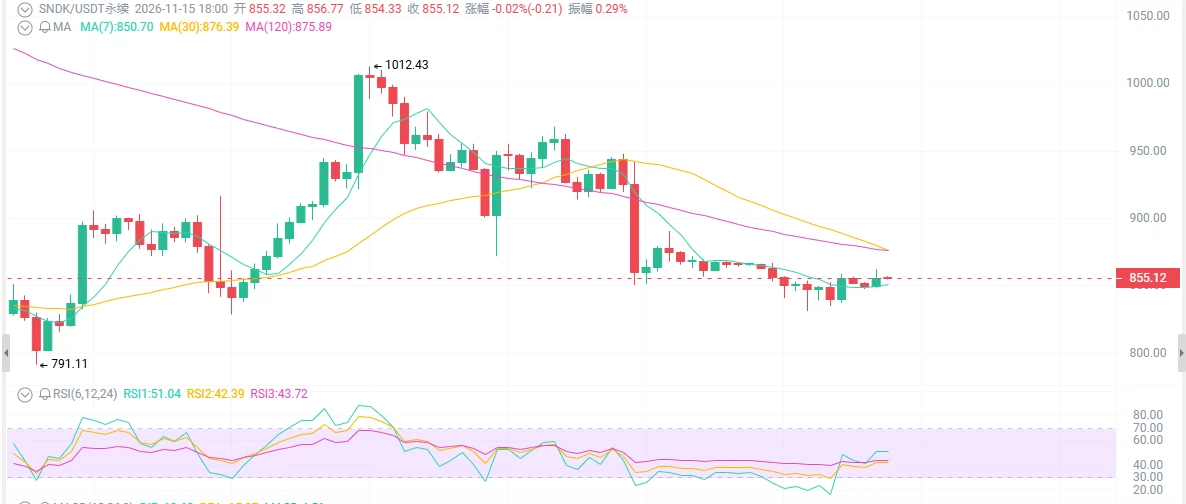
Would you buy SNDK at $855?
From 2350 to 855, down 60% in four months. Everyone is shouting, “The AI storage bubble has burst”—but just now, an 8-for-1 stock split entered the countdown, revenue surged 378% in the earnings report, gross margin hit 85%, and the company bought back $5 billion in a single quarter. Is this plunge really a cyclical peak, or the last drop before you get scared out of your position?
First, the surface story: good news is out, and the stock has crashed.
The October 29 earnings report was explosive: revenue of $11.03 billion, up 378% year over year; EPS of 49.51, above guidance; data center business up 61% quarter over quarter to $4.8 billion. Sounds like it should have hit limit-up, right? Instead, the stock plunged from 2300 all the way to 855, down more than 60%.
Why? Because markets always trade expectations, not reality. You see “earnings beat expectations”; institutions see “the good news is out—better get out first.”
But at 800-820, some buyers have already started stepping in. RSI has climbed back from oversold territory, and volume has picked up around 850.
First: the split isn’t bullish by itself, but it’s a flare.
An 8-for-1 split: new shares will be issued after the market closes on November 19, and trading at the split-adjusted price begins on November 20. The theoretical price is divided by 8, taking 855 to around 107.
Sounds like a numbers game? Exactly, the split itself creates no value. But you need to understand what it means:
Management is actively lowering the barrier to entry and inviting retail investors in.
When does a company choose to split its stock? When the share price is too high, liquidity is insufficient, and it wants more people to be able to afford shares. SNDK rose from 40 to 2350, making one round lot cost $230k—out of reach for retail investors. After the split, at $107 per share, anyone can get in.
The fundamentals haven’t changed; the ownership structure is about to.
Second: You think AI storage is a bubble, but its gross margin is 85%.
You call it “a cyclical stock nearing its peak,” but its FY2027 Q1 gross margin was 85.1%. What does that mean? Moutai’s gross margin is 91%, Apple’s is 46%. A company selling flash memory has managed an 85% gross margin, and you’re telling me this is a bubble?
Data center business was up 61% quarter over quarter and now accounts for nearly half of revenue. AI training needs caching, inference needs storage, and cloud providers are still ramping up capital spending—on the day CoreWeave raised its guidance, SNDK rallied hard.
You’re selling the fear that the cycle has peaked; they’re buying the reality that AI is consuming storage.
NAND is cyclical, and supply may ease in the second half of 2027. But that’s the second half of next year. What about now? Supply is tight, long-term contract pipelines are strong, and $5 billion in buybacks provide a floor.
The most lucrative stretch for cyclical stocks has never been “the top of the cycle.” It’s when everyone doubts the cycle can keep rising.
Third: The chart is forming a base at 800, but the real battle is around the split.
On the big-picture chart: the move from 40 to 2350 was a massive rally, and the drop from 2350 to 855 was a sharp correction of more than 60%. The monthly chart remains in an uptrend, but the medium-term trend is indeed in a correction.
On the 4H/daily charts: a pattern of lower highs and lower lows, with key support at 800-820. There has been buying around 850 over the past couple of days, but volume hasn’t surged.
Key window: the split takes effect on November 19-20.
Volatility will increase before the split—some traders will get in early, others will rebalance, and perpetual contract sizes will need adjusting. After the split, the nominal price will be 107, the barrier to entry for retail investors will drop sharply, and liquidity may suddenly improve.
Historically, high-growth stocks often see increased short-term volatility after a split, but frequently attract a new wave of capital in the medium term. Apple, Tesla, and Nvidia all went through this after their splits.
The bull-bear showdown: judge for yourself
On one side:
Revenue +378%, gross margin 85%, data center business up 61% quarter over quarter
$5 billion in buybacks in a single quarter, plenty of cash, very little debt
8-for-1 stock split, improved liquidity, retail investors entering
Average analyst price target above 2000, current price 855
Buyers at 800-820, AI capital spending still expanding
On the other side:
Down 60% from 2350, medium-term downtrend still intact
NAND cycle concerns: supply may ease in the second half of 2027
Sentiment in the semiconductor sector is fragile; high-beta stocks are vulnerable to sell-offs
Volatility will increase around the split, putting leveraged positions at risk
The market is questioning whether high gross margins can last
Key levels
Resistance above: 900-950 → 1000-1100 (reversal confirmation zone)
Support below: 830-850 → 800-820 (strong floor) → 700-750 (extreme scenario)
Trading strategies
Short-term traders:
Try a small long position at 830-850, set a stop below 800, and take half off at the first target of 900-950. If 950 breaks on strong volume, follow the move and look toward 1000-1100.
Swing traders:
Wait until after the November 20 split, once the price has been repriced and liquidity has stabilized. Buy low and sell high within the 800-950 range; consider adding only after a breakout above 950 holds. After the split, the nominal price will be 107, so recalculate your stop-loss level—don’t use the old pre-split reference points.
Long-term believers:
Build a position in batches below 800; 700-750 would be a gift from the market. Demand for AI storage isn’t a one- or two-year story, and it’s rare to see a company with an 85% gross margin fall 60%. But remember: NAND is cyclical. Don’t hold cyclical stocks with the mindset that they’ll “go up forever.” Target 1200-1500 (the equivalent pre-split price), and take profits in batches when it gets there.
Is SNDK finished after falling from 2350 to 855?
Where were you when it rose from 40 to 2350 in 2025?
Back then, you also thought, “Why should a company selling flash memory go up?”
Markets are always like this: good companies fall harder than shitcoins because nobody believes they can climb back up.
$BTC $ETH $SNDK $NVDA #10月PPI低于预期 #Dr.Han牛津辩论社演讲 #Gate直通IPO第三期Anthropic