The boundary between traditional financial markets and crypto markets is gradually changing through tokenized assets, stablecoin settlement, and digital trading infrastructure. Stock tokenization is one representative attempt: It uses traditional stocks as underlying reference assets and provides access to them in tokenized form, allowing users to gain exposure to assets linked to traditional securities prices within a digital asset trading environment.
智谱 AI provides a specific case for observing this shift. As an artificial intelligence company focused on the research, development, and commercialization of general-purpose large models, 智谱 AI has entered the public stock market. With ZHIPUG, the relevant tokenized securities trading instrument, listed on Gate gStocks, market participants can observe the same AI company from different perspectives: on the one hand, as a listed company in the Hong Kong stock market, and on the other, as a tokenized securities product on a crypto trading platform.
However, stock tokenization does not mean that all ownership rights and trading rules from traditional stock markets are fully replicated on crypto platforms. The underlying stock, token issuance and reserve arrangements, the matching services provided by the trading platform, and the economic rights actually obtained by users all need to be understood separately. Only by distinguishing these layers can users accurately understand how ZHIPUG represents a connection between TradFi and crypto markets.
Key Takeaways
-
ZHIPUG is a tokenized securities trading instrument for 智谱 AI offered through Gate gStocks. It is linked to the performance of 智谱 AI, a company listed in Hong Kong, but it is not equivalent to directly holding the native stock.
-
Tokenized securities connect traditional securities with digital asset trading environments through underlying asset reserves and price mapping. Reserve mechanisms do not eliminate price, liquidity, or issuer risks.
-
USDT-denominated pricing and the platform order book lower some operational barriers to trading, but users still need to understand the product’s rights, trading hours, fees, and applicable regional restrictions.
Why Are TradFi and Crypto Markets Beginning to Connect?
Traditional financial markets and crypto markets rely on different infrastructures. Stocks are typically traded and settled through stock exchanges, brokers, custodians, and clearing systems. Digital asset trading relies more heavily on crypto trading platforms, digital wallets, on-chain protocols, and stablecoin settlement. The two markets differ significantly in asset registration, trading hours, how funds are used, and regulatory arrangements.
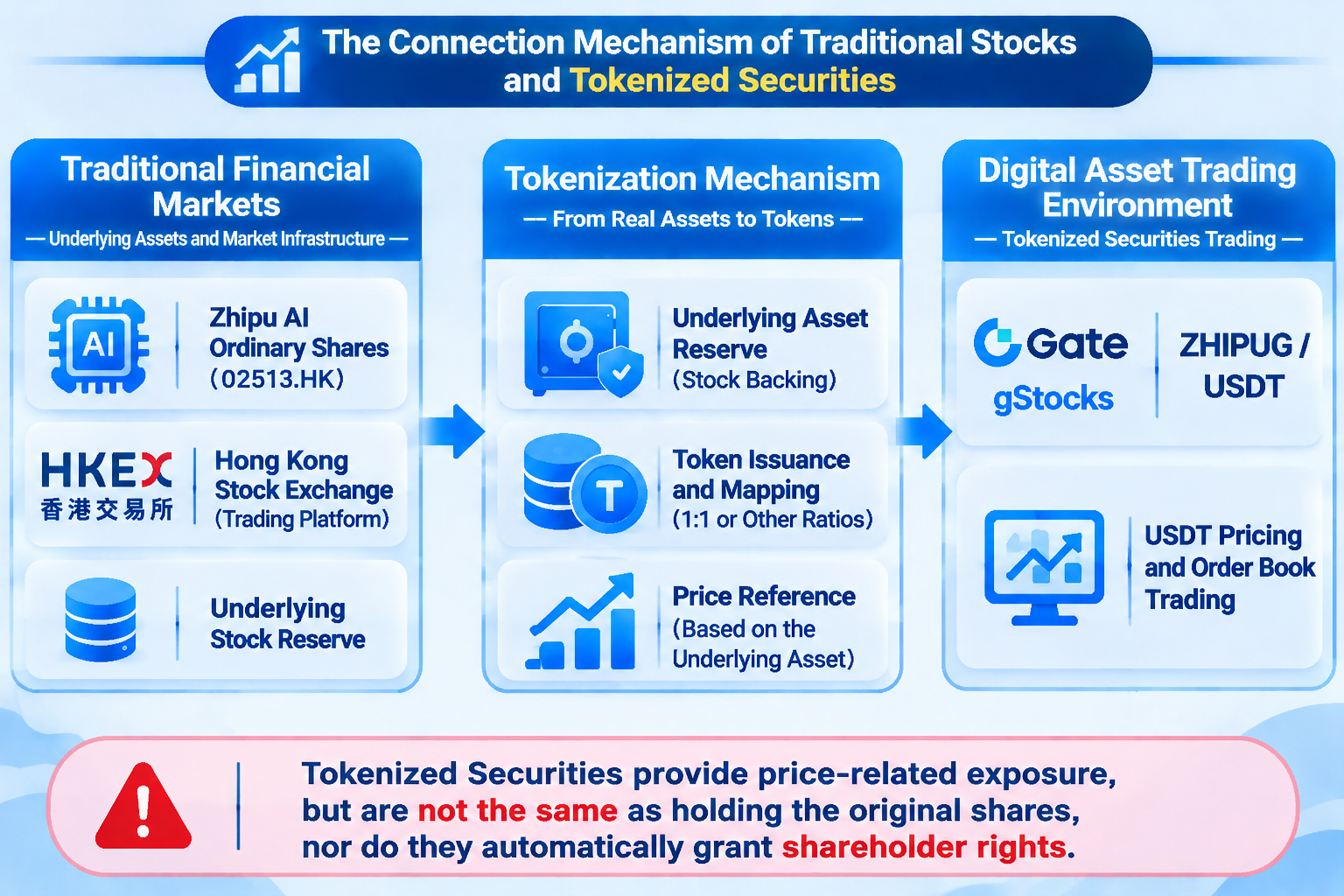
Tokenized securities attempt to establish a connection between these two systems. The basic idea is to use traditional securities or other financial assets as underlying references, represent the corresponding price exposure or economic rights through tokens, and provide support through issuance arrangements, reserve assets, and trading platforms. Users can trade the relevant tokens on a digital asset platform without fully following the procedures required for a traditional securities account.
The appeal of this model mainly comes from differences in trading infrastructure. For example, digital asset platforms can use USDT as the pricing unit and match buy and sell orders through an order book. Some tokenized securities products also offer trading services close to 24/7. However, changing the trading venue does not mean that the trading and settlement rules of the underlying securities market change at the same time. Traditional stocks remain subject to factors such as the trading rules of their listing venue, corporate actions, and market liquidity.
Therefore, understanding the integration of TradFi and crypto markets requires more than determining whether an asset has been tokenized. It also requires analyzing who holds the underlying asset, who issues the token, how the price is mapped, and what actual rights users can obtain. Together, these arrangements determine the relationship between tokenized securities and traditional stocks.
智谱 AI’s Listing Background and ZHIPUG’s Asset Positioning
智谱 AI, also known as Z.ai, is a technology company focused on general-purpose artificial intelligence foundation models. Its business includes large model research and development, model services, and related artificial intelligence applications. The company’s GLM series models form an important part of its technological foundation, while its commercialization efforts include model services and application solutions for developers and enterprise customers.
智谱 AI was listed on the Main Board of the Hong Kong Stock Exchange on January 8, 2026, under the stock code 02513.HK. Its listing brought the company into the public capital market, allowing investors to observe its operating performance, financing capabilities, research and development investment, and market valuation through the Hong Kong stock market. For an AI company still undergoing technological iteration and commercial expansion, its public market price may reflect not only current operating data but also market expectations regarding future model capabilities and the competitive landscape.
ZHIPUG is the tokenized securities trading instrument corresponding to 智谱 AI on Gate gStocks. In an announcement published in July 2026, Gate announced the launch of ZHIPUG/USDT trading and described gStocks as a tokenized securities product backed by fully reserved native stocks on a 1:1 basis. Users can use USDT to trade ZHIPUG on Gate’s trading page.
It is important to note that ZHIPUG and 02513.HK cannot simply be treated as the same asset. The former is a tokenized securities product, while the latter is the native stock of a company listed on the Hong Kong Stock Exchange. Although they are linked through the underlying price, they differ in their holding formats, rights arrangements, trading mechanisms, and potential counterparty risks. When analyzing ZHIPUG, users should consider both 智谱 AI’s stock performance and the structure of the tokenized product itself.
How Does Stock Tokenization Work?
Stock tokenization typically involves multiple components, including the underlying asset, the issuer or arranging entity, reserve custody, price mapping, and the trading platform. The underlying stock provides the reference value, reserve arrangements support the quantitative relationship between the token and the native stock, and the price-mapping mechanism helps the token’s trading price track changes in the underlying asset. The trading platform displays market information and provides the relevant order-matching environment.
Gate’s introduction to gStocks emphasizes fully reserved native stocks on a 1:1 basis. This means that the number of tokens in circulation is quantitatively mapped to the corresponding reserve of underlying stocks. This design primarily addresses whether the tokens are backed by corresponding assets. However, it does not mean that the token price cannot decline, nor does it mean that the reserve mechanism can completely eliminate issuance, custody, redemption, or counterparty risks.
In addition, the economic rights associated with tokenized securities must be determined according to the specific product rules. Gate’s Tokenized Stock FAQ explains that the relevant tokens are not native stocks directly issued by the company, and holding them does not give holders voting rights, dividend rights, or corporate governance rights in the underlying stock. Therefore, users should not interpret purchasing ZHIPUG as directly becoming a shareholder of 智谱 AI, nor should they assume that they have exactly the same rights as someone holding 02513.HK in a Hong Kong stock account.
From a risk perspective, tokenized securities involve at least three layers of relationships: changes in the underlying stock price, token issuance and reserve arrangements, and buying and selling liquidity on the trading platform. Even if the underlying stock price remains relatively stable, the token’s trading market may experience price deviations because of insufficient buy or sell orders, changes in trading demand, or differences in product mechanisms. Understanding these components is an important prerequisite for evaluating tokenized securities.
What Do USDT-Denominated Pricing and 24/7 Trading Change?
Traditional stock markets generally operate during trading hours set by the relevant exchange and are affected by local holidays, market opening and closing times, and settlement systems. Digital asset trading platforms can provide trading services for longer periods. Gate’s introduction to gStocks includes a 24/7 trading arrangement, and ZHIPUG/USDT also uses USDT as its trading denomination, allowing users to participate in the relevant trading through a digital asset account on the platform.
The primary function of USDT-denominated pricing is to provide a unified pricing and settlement unit. For users who already hold USDT, trading tokenized securities from different markets does not require them to first exchange their assets for the relevant fiat currency each time. However, USDT-denominated pricing does not mean that the underlying stock is traded in U.S. dollars, nor does it mean that the price-formation mechanism of the Hong Kong stock market has been removed. The underlying stock remains based on the quotation and trading system of its native market.
24/7 trading must also be understood in the context of the underlying market’s operating status. When the Hong Kong stock market is closed, the relevant tokenized product may still be traded on the platform, but the underlying stock may not generate a new transaction price at the same time. As a result, the token price may be influenced more by traders’ expectations, information from other markets, and order supply and demand, potentially causing it to differ from the latest underlying stock price.
Therefore, 24/7 trading provides flexibility in trading hours and platform operations. It does not guarantee sufficient liquidity or precisely synchronized prices at every moment. Users should pay attention to whether the underlying market is open, when the reference price was last updated, the bid-ask spread, and order-book depth. They should not assume that market conditions are always the same simply because the trading page remains open.
Key Risks and Rights Boundaries of Tokenized Securities
Tokenized securities bring traditional assets into a digital trading environment, but they also introduce risks that differ from those of directly holding native stocks. The first is underlying asset risk. 智谱 AI’s stock price may be affected by the company’s operations, research and development investment, industry competition, financing needs, and changes in market valuation. Tokenization does not change these fundamental factors.
The second is the risk associated with the product structure and issuance arrangements. Users need to understand who issues or arranges the token, who holds the underlying stocks in custody, how the reserves are verified, and how issues involving the issuer or related service providers would be handled. Even if a product discloses a 1:1 reserve arrangement, users should still read the specific rules and risk disclosures. A quantitative correspondence between tokens and reserves should not be interpreted as a guarantee against all losses.
The third is market trading risk. The liquidity of tokenized securities on a digital asset platform may differ from that of the underlying stock market. Insufficient market depth, wider bid-ask spreads, closure of the underlying market, or sudden changes in trading demand may increase transaction costs. If the token price deviates from the reference price of the underlying stock, users also need to consider the cause of the deviation and how long it may persist.
The final consideration is the boundary of rights. Tokenized securities do not necessarily grant users the same rights as native stockholders. For ZHIPUG, users should refer to Gate’s product information and applicable rules, paying particular attention to the distinction between price exposure, underlying reserves, and shareholder rights. Understanding exactly what they hold is more important than simply focusing on the token price.
What Trading Access Does Gate gStocks Provide for ZHIPUG?
Gate gStocks includes 智谱 AI in its range of tokenized securities and provides a ZHIPUG/USDT trading venue. Users can view relevant market information on Gate’s ZHIPUG/USDT trading page and use USDT to trade. Gate’s related announcement lists ZHIPUG as a tokenized securities spot trading instrument on gStocks and states that the product uses a fully reserved native stock arrangement on a 1:1 basis.
This venue represents one way in which TradFi and digital asset trading platforms can connect: the underlying reference asset comes from the traditional stock market, while trading is completed through the digital asset platform’s product interface and order book. When conducting research, users should consider both 智谱 AI’s fundamentals and price movements in the Hong Kong stock market and ZHIPUG’s own quotation, trading volume, bid-ask spread, and market depth.
However, trading ZHIPUG on Gate should not be understood as directly purchasing the native 02513.HK stock registered on the Hong Kong Stock Exchange. The holding rights, trading hours, fees, issuance and reserve arrangements of the tokenized product are subject to the specific product rules. Users in different regions should also confirm whether the relevant services are available to them.
FAQ
Is ZHIPUG the Native Stock of 智谱 AI?
No. ZHIPUG is a tokenized securities trading instrument on Gate gStocks that is linked to 智谱 AI’s stock. The native stock of 智谱 AI listed on the Hong Kong Stock Exchange has the stock code 02513.HK. The two differ in their holding formats and rights arrangements.
What Is the Relationship Between ZHIPUG and 02513.HK?
ZHIPUG’s price is linked to the underlying stock of 智谱 AI, but ZHIPUG is a tokenized securities product. Users should separately understand the underlying stock price, the token reserve arrangements, and the market price on the trading platform.
Does Holding ZHIPUG Grant Shareholder Rights in 智谱 AI?
Holding ZHIPUG should not be considered sufficient to establish that the holder has the shareholder rights associated with the native stock. Gate’s Tokenized Stock FAQ explains that holders of the relevant tokens do not thereby obtain voting rights, dividend rights, or corporate governance rights in the underlying stock. Specific rights are subject to the product rules.
Why Can ZHIPUG Be Traded Using USDT?
USDT is the pricing unit used on Gate’s trading page, making it convenient for users to quote and settle trades within a digital asset trading account. However, this does not change the listing venue or trading system of 智谱 AI’s native stock on the Hong Kong Stock Exchange.
Are Tokenized Stocks Free From Price Risk?
No. A 1:1 reserve arrangement addresses the quantitative correspondence between the token and the underlying stock. It does not guarantee a stable token price. Underlying stock volatility, market liquidity, product structure, and issuer risks still exist.