The development of DeFi allows users to access services such as lending, trading, liquidity provision, and yield management across different blockchains. Ethereum and its Layer 2 networks, Solana, and other public blockchains continue to develop their own application ecosystems, providing users with more choices while making on-chain financial markets more diverse.
However, ecosystem expansion has also introduced new usability costs. Users may hold stablecoins on one chain, trading assets on another, and need to use a DeFi protocol on a third chain. To complete a single operation, users may need to switch networks, connect different wallets, find a cross-chain bridge, prepare Gas on the target chain, and confirm whether their assets have arrived. Although liquidity is distributed across multiple networks, users may not be able to access it conveniently as a whole.
Chain abstraction has gained attention in this context. It does not require all blockchains to merge into a single chain. Instead, it attempts to hide the complexity of accounts, assets, and transaction execution at the infrastructure layer, allowing users to start with their application objectives rather than the underlying networks. Particle Network's Universal Accounts are one representative design in this area.
Key Points
-
The main sources of friction in multichain DeFi are the fragmentation of accounts, assets, liquidity, and Gas.
-
Universal Accounts reduce the complexity of managing multichain assets through a unified account entry point and balance view.
-
Universal Liquidity coordinates cross-chain asset routing, swaps, and transaction execution, allowing assets distributed across different chains to participate in operations on the target chain.
-
Universal Gas aims to allow users to pay transaction fees with tokens they already hold, reducing the need to prepare native Gas assets for each chain.
-
Chain abstraction does not eliminate cross-chain risks. Liquidity, messaging, smart contracts, and execution failures still require evaluation.
Why Does Liquidity Fragmentation Occur in Multichain DeFi?
DeFi liquidity is typically distributed across different networks, protocols, and asset pools. Even when the same token exists on multiple networks, its liquidity depth, trading price, and use cases may differ. Holding assets on one chain does not mean that those assets can be directly used for lending or trading on another chain.
This fragmentation is reflected not only in asset balances but also in transaction entry points and protocol environments. Different networks may have separate wallet connection methods, smart contract addresses, transaction fee structures, and risk parameters. Users who want to move funds across multiple networks need to understand the operating rules of each chain and bear the time, cost, and execution risks associated with cross-chain transfers.
For DeFi applications, liquidity fragmentation can also affect user conversion and capital efficiency. Even if a protocol has a well-designed product, the actual barrier to use may remain high if users must first purchase the target chain's native token, transfer assets across chains, and complete multiple authorizations. For new users, these steps may be more complicated than the protocol's financial functions themselves.
Therefore, chain abstraction aims not to automatically aggregate all liquidity into a single smart contract, but to allow users to access assets and applications distributed across different chains through a unified interaction entry point. It focuses on the accessibility of cross-chain resources and the transaction execution experience rather than simply changing where assets are held.
How Do Particle Network's Universal Accounts Work?
Universal Accounts are Particle Network's core chain abstraction product. According to the project's documentation, the design is based on smart accounts deployed and coordinated across chains, providing users with a unified account entry point, balance view, and application interaction method. Users can access the relevant account capabilities through Particle's wallet services or by connecting an existing Web3 wallet.
From a user experience perspective, Universal Accounts aim to eliminate the need for users to first determine which chain holds their assets and then manually switch networks or find a bridging route for every transaction. Users can view assets on different networks in a unified interface and initiate operations based on the requirements of the target application. For developers, integrating the Universal SDK allows account abstraction capabilities to be incorporated into application workflows, reducing the extent to which users need to directly handle differences between underlying networks.
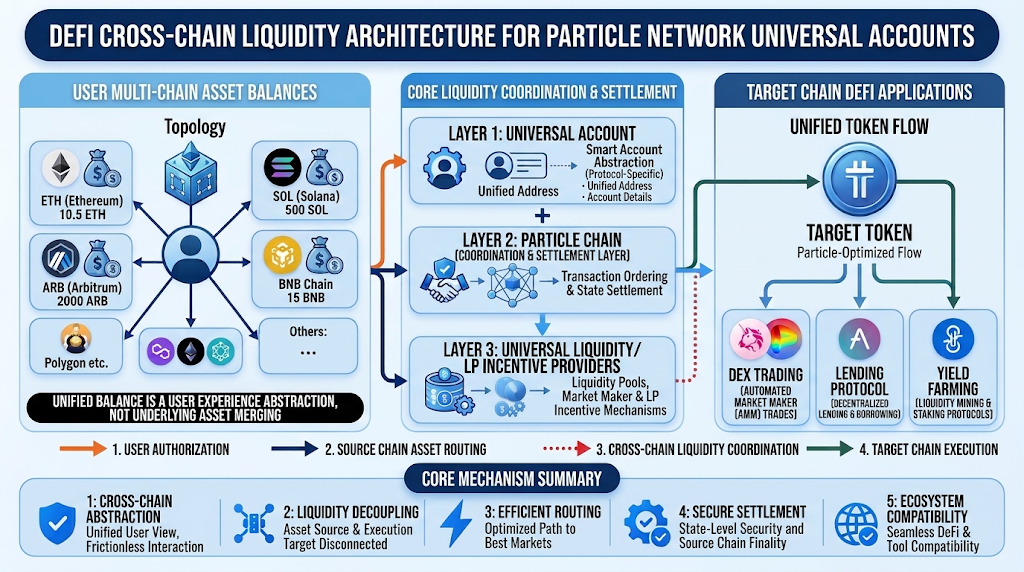
However, it is important to understand the meaning of "one account" and "one balance" accurately. These terms refer to a unified abstraction of cross-chain account status and asset availability. They do not mean that assets on different chains have been directly transferred to the same physical ledger, nor do they mean that the underlying blockchains have lost their independence. Each chain still maintains its own asset status, transaction execution, and settlement rules. Cross-chain operations must be completed through Particle Network's coordination layer and related liquidity infrastructure.
How Does Universal Liquidity Use Multichain Assets for the Same DeFi Operation?
Universal Liquidity is an important foundation of Universal Accounts. Its goal is to allow users to use assets on different chains to complete operations on a target chain without first manually carrying out a series of separate cross-chain transfers. Particle Network coordinates cross-chain transactions through Particle Chain and completes asset routing through liquidity providers and swap mechanisms on the relevant chains.
For example, a user may hold some USDT on Base and another amount of USDT on Arbitrum, and want to purchase an asset on Solana. Under the traditional approach, the user would need to handle asset bridging, swapping, and the target-chain transaction separately. A chain abstraction solution instead attempts to organize the user's desired operation into a set of coordinated cross-chain steps, allowing the user to initiate the operation through one primary authorization.
During underlying execution, the system may need to swap tokens on the source chain, converting the assets into an intermediary asset accepted by liquidity providers. It may then release the corresponding value on the target chain through a cross-chain liquidity network before completing the swap or contract interaction on the target chain. The specific execution path depends on the asset type, target chain, liquidity conditions, and application integration method.
Therefore, a "unified balance" does not mean that all tokens across different chains are simply added together and can then be used unconditionally anywhere. It is closer to an available balance experience supported by cross-chain transactions and liquidity routing. Users see a unified operation entry point, while the underlying system still needs to complete asset swaps, cross-chain coordination, and execution on the target chain.
How Can Universal Gas Lower the Barrier to DeFi Transactions?
In addition to asset fragmentation, Gas management is another major obstacle to the multichain DeFi experience. Different blockchains typically use different native tokens to pay transaction fees. Even when users hold sufficient trading assets, they may be unable to complete an operation because they do not have the target chain's Gas token.
Universal Gas aims to reduce this problem. Particle Network's design uses account abstraction mechanisms such as Paymasters to allow users to pay transaction fees with other tokens they hold, rather than requiring them to always prepare the native Gas asset for each target chain. The relevant fees are ultimately settled through mechanisms provided by Particle Network, with PARTI playing an important role in Particle Chain and the Universal Gas system.
From a DeFi user's perspective, this design can reduce the preparation steps required before a transaction. For example, users do not need to purchase a small amount of the target chain's native token and transfer it to their wallet solely to execute a transaction on that chain. For users who conduct cross-chain operations frequently, this simplified experience may have practical value.
However, Gas abstraction does not mean that transaction costs disappear. Target-chain execution fees, cross-chain liquidity costs, swap spreads, and potential service fees still exist at the underlying level. Users need to pay attention to the final transaction quote, fee composition, and execution result rather than judging whether a transaction is inexpensive solely by whether the interface displays payment in the native Gas token.
How Could Chain Abstraction Change the Design of DeFi Applications?
The potential value of chain abstraction is reflected not only in user wallets but also in the product design of DeFi applications. Traditional applications often require users to first enter a designated network and then prepare the corresponding assets and Gas. The application workflow is therefore constrained by the chain environment, and users may abandon an operation because their assets are held on another network.
If an application integrates chain abstraction infrastructure such as Universal Accounts, it can attempt to shift the interaction logic from "select a network and prepare assets" to "select a target operation." For example, if a user wants to deposit stablecoins into a lending application, the application may identify the user's cross-chain assets within the supported scope and coordinate the necessary fund routing. Trading platforms, payment applications, NFT marketplaces, and other on-chain services may adopt similar approaches.
This would change the problems developers need to handle. Developers would not need to devote all their resources to account connections and user asset preparation processes for every network, and could instead allocate more resources to product logic. However, this does not mean that cross-chain complexity disappears. Rather, some of that complexity is transferred to the underlying coordination infrastructure. Applications still need to handle failed rollbacks, transaction status, authorization security, supported assets, and exception notifications.
For DeFi protocols, chain abstraction may also enable new ways to organize liquidity. Users may no longer select a protocol based solely on their wallet balance on a particular chain, and could instead complete operations using a broader range of asset sources. However, the actual effectiveness of liquidity routing still depends on the depth of funds on each chain, execution speed, transaction costs, and the ability of liquidity providers to fulfill their obligations.
What Risks Does Chain Abstraction Face in DeFi?
The first is cross-chain execution risk. A user operation that appears simple may involve transactions, messaging, asset swaps, and state confirmations across multiple networks. Delays or failures at any point may affect the final result. Users need to understand whether the transaction has been executed on the source chain, whether settlement has been completed on the target chain, and how assets are handled if execution fails.
The second is liquidity risk. Cross-chain transactions require available liquidity providers and funds on the target chain. If an asset has insufficient liquidity, the transaction may experience a significant price spread, execution delays, or failure to complete. Even if the interface displays a unified balance, this does not mean that all assets can be converted at the same price and speed at any given time.
The third is smart contract and account security risk. Universal Accounts involve smart accounts, authorization logic, cross-chain messaging, and related infrastructure. Account abstraction can improve the interaction experience, but it also introduces new contract and execution dependencies. Users need to pay attention to account recovery mechanisms, the scope of signing authorizations, contract audits, and protocol upgrade permissions.
Finally, there is system dependency risk. Chain abstraction is not a universal layer that operates independently of underlying blockchains. It still depends on the normal operation of target chains, the correct processing of messages and transactions, and the continued availability of liquidity networks. The more complex the infrastructure's coordination capabilities, the more users need to understand its failure-handling and risk-isolation mechanisms.
How Should the Long-Term Significance of Particle Network for DeFi Be Evaluated?
When evaluating Particle Network, the first consideration should be the actual use of Universal Accounts, including the number of integrated applications, active accounts, cross-chain transaction volume, and user retention. The technical architecture can explain how the system is designed, but only sustained use by real users can demonstrate whether the product effectively reduces the cost of multichain operations.
The second consideration is the execution quality of Universal Liquidity. Cross-chain transaction success rates, completion times, liquidity depth, transaction costs, and failure-handling mechanisms are more meaningful indicators of service capability than the number of supported chains alone. Supporting more networks may expand the application's scope, but if liquidity and execution quality are unstable on each chain, the user experience may still be limited.
The third consideration is ecosystem integration. Whether Universal Accounts can be continuously adopted by DeFi protocols, wallets, trading applications, and other infrastructure will affect its network effects. Whether developers are willing to integrate it, users are willing to migrate, and protocols can obtain real benefits from it are all important indicators of its long-term development potential.
Finally, infrastructure growth must be distinguished from token value. Particle Network's PARTI is related to Particle Chain, Universal Gas, network governance, and ecosystem economic mechanisms. However, growth in ecosystem usage does not necessarily translate into a fixed proportionate increase in the token's price. Researchers need to independently assess the token's utility, fee settlement, circulating supply, and actual demand.
Gate and Particle Network: From DeFi Research to the Token Market
Users who want to learn more about Particle Network can conduct research using the project's official documentation, ecosystem applications, and market information. The design of Universal Accounts focuses on simplifying the use of multichain assets. It does not mean that users can disregard the risks associated with target chains, smart contracts, and cross-chain transactions.
Gate provides a PARTI/USDT spot trading market. Users can view market information on the PARTI/USDT trading page and consult Particle Network's official documentation to learn about the technical positioning of Universal Accounts, Universal Liquidity, and Universal Gas.
It is important to note that trading PARTI and using Universal Accounts are different activities. Holding or trading PARTI does not mean that a user has used chain abstraction services, nor does it mean that the user can automatically obtain cross-chain trading returns or protocol distributions. Users should separately assess the project's technological development, tokenomics, and market trading risks.
FAQ
What Are Particle Network's Universal Accounts?
Universal Accounts are Particle Network's chain abstraction account solution. They aim to provide users with a unified cross-chain account entry point and balance view, making it easier for users to access assets and applications on different blockchains.
Do Universal Accounts Mean That Assets on All Chains Have Been Merged?
No. A unified balance is an abstraction of the display and availability of cross-chain assets. Assets remain on their respective blockchains, and cross-chain operations must be completed through liquidity routing, transaction coordination, and execution on the target chain.
How Does Universal Liquidity Differ from a Cross-Chain Bridge?
Traditional cross-chain bridges generally focus on transferring assets from a source chain to a target chain. Universal Liquidity places greater emphasis on coordinating multichain assets, swaps, and liquidity providers around the user's target operation, allowing the cross-chain process to be integrated into a unified account interaction. The specific security model and execution path must still be evaluated based on the actual protocol design.
Does Universal Gas Mean That Users Do Not Need to Pay Gas Fees?
No. It primarily changes how users pay Gas and reduces the need to prepare native Gas tokens for each chain. Underlying transaction fees, swap costs, and cross-chain service costs still exist.
What Is the Role of Particle Network's PARTI?
According to the project's official token materials, PARTI is related to mechanisms including Gas settlement on Particle Chain, settlement associated with Universal Liquidity, network security, and governance. Its specific uses and actual implementation should be based on the latest official documentation.
Will Chain Abstraction Eliminate Cross-Chain Risks in DeFi?
No. Chain abstraction can hide some operational complexity, but the underlying system still depends on cross-chain messaging, smart contracts, liquidity providers, and execution on the target chain. Users still need to pay attention to contract risks, liquidity risks, and transaction failure handling.