When comparing mainstream U Card types, safety is often the first question users ask before choosing a product. Whether a U Card is safe cannot be answered by “does it work at checkout” alone. The assessment must cover issuer background, account rules, top-up and withdrawal paths, regional limits, privacy handling, and how risk controls are triggered. Much of the anxiety around U Cards comes not from the card label itself, but from unclear underlying rules. Users often worry less about the card form factor and more about whether the operating rules are transparent and verifiable.
A U Card sits at the intersection of digital-asset funding and card-network payment. That hybrid structure means safety spans several layers: who holds funds, how identity is verified, which regions and merchants are supported, and what behavior can pause spending or withdrawals. U Card vs bank card vs prepaid card explains how those structural differences shape custody and compliance duties. The sections below break safety into measurable dimensions rather than treating it as a single yes-or-no label.
What Dimensions Should Be Used to Judge U Card Safety?
At minimum, five dimensions matter: issuer, payment network, account risk controls, fund path, and data privacy.
The issuer defines compliance foundation and operational stability. Payment-network support determines whether the card works at real merchants and ATMs. Account risk controls set usage boundaries—limits, freezes, and review triggers. The fund path covers how digital assets are topped up, converted, and withdrawn. Data privacy covers how identity documents and transaction records are stored, shared, and protected.
From a usage perspective, the critical question is not only “can this card pay,” but whether payment is backed by clear, stable, and verifiable rules. A U Card that feels smooth at checkout can still carry higher long-term risk if withdrawal rules, regional support, or risk-control logic are opaque. Predictability over time usually matters more than a frictionless first transaction.
Why Do Compliance and KYC Affect the U Card Experience?
KYC is not a risk by itself. It is a tool issuers use to confirm identity, define payment boundaries, and meet regional regulatory requirements. For users, the direct effect is tiered capability: different verification levels often map to different top-up, spending, withdrawal, and cross-border limits. Higher limits and more stable service usually require more complete identity checks.
A common mistake is treating “less paperwork” as “better experience.” Lower entry barriers can feel convenient in the short term, but unclear compliance conditions and vague identity rules often surface as restrictions during heavy use, withdrawal attempts, or cross-border payments. KYC adds upfront friction, yet in many cases it is a precondition for stable long-term use rather than an optional extra step.
Compliance also shapes which regions and features remain available. Issuers may restrict certain countries, merchant categories, or withdrawal channels based on licensing scope. Users who skip reading those boundaries may interpret a later block as a sudden safety failure when it is actually an enforced rule that was always present.
What Are the Main Fund Risks With U Cards?
Most U Card fund risk appears during path conversion—not necessarily as outright loss, but as value that cannot be used as expected.
The first category is top-up path errors: sending assets on an unsupported network or through a channel the issuer does not recognize. The second is FX and conversion loss: the displayed balance may not match expected value after spread, fees, or rounding. The third is failed withdrawal or failed payment: the account shows a balance, but value cannot be extracted or spent. A fourth category comes from issuer or intermediary rule changes—regional contraction, service suspension, or revised limits.
These risks share a pattern: assets may not disappear, yet they cannot move on the expected timeline or route. For most users, practical safety means reducing unclear paths, unknown rules, and high-friction trial-and-error operations. Identifying these categories early makes later freezes and limits easier to anticipate.
The U Card cash withdrawal flow adds another layer. Cash-out often depends on physical-card support, ATM network compatibility, daily limits, and local acquirer rules. A balance that spends smoothly online may still face extra checks at an ATM or when moving back to on-chain wallets.
How Do Technical Security, Data Privacy, and Account Risk Controls Differ?
These three risk types feel similar when something goes wrong, but they originate in different systems. Separating them helps diagnose whether a problem is theft, data exposure, or policy enforcement.
| Risk type |
Main manifestations |
Typical impact |
| Technical security |
API vulnerabilities, account takeover, system outages |
Asset loss or interrupted operations |
| Data privacy |
Leakage or misuse of identity and transaction data |
Privacy exposure, phishing, or secondary abuse |
| Account risk controls |
Payment blocks, withdrawal holds, spending limits |
Service interruption without necessarily losing funds |
| Compliance risk |
Regional restrictions, product sunset, rule changes |
Long-term availability declines |
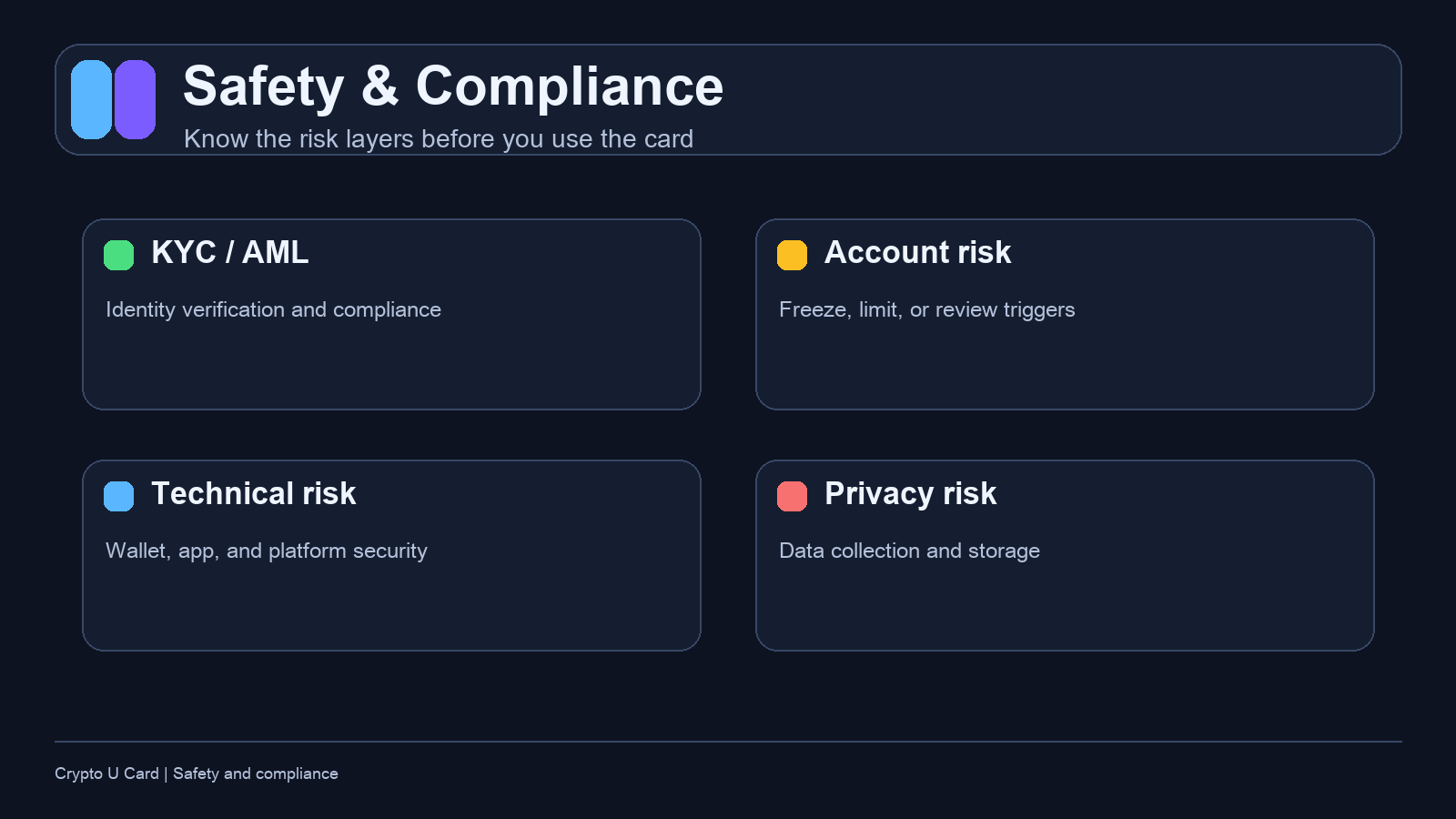
Technical security focuses on whether accounts can be compromised and whether infrastructure remains stable. Data privacy focuses on how KYC documents, contact details, and transaction histories are collected, retained, and shared with partners. Account risk controls sit closest to daily experience: many perceived “safety problems” appear as declined payments or paused withdrawals rather than missing balances.
Compliance risk is often slower-moving but equally important. A product that works today may lose regional coverage after a licensing update. Users who treat current availability as permanent may be surprised when a previously supported country or feature is removed.
Which Behaviors More Often Trigger Limits or Freezes?
Issuers monitor patterns that suggest fraud, sanctions exposure, or inconsistent identity signals. Typical triggers include abnormal login locations, high-frequency payments in a short window, mismatch between registration region and actual use region, and funding paths that lack clear provenance.
Restrictions during U Card cash withdrawal flow often reflect the whole funding chain, not a single action. Frequent device changes, multi-region logins, or repeated cross-border charges of similar amounts can raise risk scores. Trial-and-error payments—many small attempts after declines—may also look like probing behavior.
Cross-border use adds sensitivity. Even when a card advertises global acceptance, risk engines may apply stricter review for foreign merchants, VPN-associated logins, or sudden shifts in spending geography. Users planning travel or remote work should align account profile, funding source, and expected merchant regions before heavy use begins.
Fee structure can indirectly affect risk perception. Unexpected FX spread or network charges may lead users to repeat transactions quickly, which in turn triggers velocity controls. Reviewing U Card fees: top-up, FX, ATM withdrawal before high-frequency use reduces both cost surprises and behavior patterns that look anomalous to risk systems.
How Can U Cards Be Used More Reliably?
Reliable use starts with selecting products whose rules, regional scope, and fee schedules are documented clearly. Before the first top-up, users should confirm supported networks, available countries, withdrawal conditions, and limit tiers—not after a failed payment forces a search through help pages.
Operational habits matter as well. Avoid rapid repeated attempts after declines, keep login devices and regions reasonably consistent, and maintain a clear purpose for cross-border charges. Large one-off tests followed by immediate withdrawal may look like account verification abuse even when the user’s intent is innocent.
Keeping transaction records and account activity logs helps in two ways. They support fee and outcome review over time, and they provide evidence if the issuer requests explanation during a manual review. For cross-border plans, pairing this checklist with U Card for cross-border payments vs bank wire clarifies where card payment fits and where bank transfer remains more appropriate.
No U Card removes all counterparty, regulatory, or operational risk. The goal is informed use: knowing which layer—compliance, technology, risk control, or fund path— governs each failure mode, and choosing products whose rules remain readable before problems occur.
Summary
U Card safety depends less on whether the product is “crypto-related” and more on whether issuer rules, fund paths, and privacy handling are transparent. A practical assessment splits safety into compliance, technology, risk controls, and fund usage rather than treating approval at checkout as proof of reliability. Clearer rules usually improve long-term predictability and make it easier to trace where a restriction or loss originated.
FAQ
Is a U Card safe?
A U Card can be used safely, but safety is not automatic. It depends on the issuer, account rules, funding and withdrawal paths, payment-network support, and user behavior. The full usage chain—not just successful payment—should be evaluated.
Why do U Cards get frozen?
Common triggers include abnormal login patterns, high-frequency unusual payments, region mismatch, and unclear funding sources. Freezes are usually risk-control outcomes rather than isolated technical glitches. Understanding account rules in advance reduces surprise when review occurs.
Is KYC always required for a U Card?
Not always at basic tiers, but higher limits, withdrawals, and cross-border use often require fuller verification. Whether KYC is mandatory depends on issuer policy, regional regulation, and feature scope. Stronger KYC tiers frequently correlate with more stable long-term access.
Are anonymous U Cards riskier?
Higher anonymity does not automatically mean lower risk. Low-barrier products may offer weaker long-term availability, lower limits, opaque compliance paths, and sharper risk responses. For stable spending or cross-border use, rule clarity often matters more than minimal identity collection.
What are the main fund risks with U Cards?
They include top-up path errors, FX and conversion loss, failed withdrawals or payments, account restrictions, and issuer or channel rule changes. Many risks do not show up as missing assets but as assets that cannot be used on the expected route or timeline.