For crypto investors and traders—including beginners who want a simpler, more systematic way to invest regularly—this approach automates recurring buys instead of relying on a single market entry. Gate currently supports hourly, daily, weekly, biweekly, and monthly schedules, and this guide explains how to set up and manage Auto Invest plans, how DCA works in crypto, how it compares with lump-sum investing, what fees and common mistakes to watch for, and how Auto Invest connects with Gate Earn products. Auto Invest can reduce the need to manually decide when to make every purchase, but it does not guarantee a lower cost basis or a profit; its value is in keeping purchases consistent across volatile market conditions rather than concentrating on an entire investment at one entry price.
Key Takeaways
-
Gate Auto Invest automates recurring crypto purchases using a predetermined amount and schedule.
-
Users can choose from hourly, daily, weekly, biweekly, and monthly investment frequencies.
-
Dollar-cost averaging means investing equal amounts at regular intervals regardless of market conditions. This causes users to buy more units when prices are lower and fewer when prices are higher.
-
DCA can reduce dependence on a single entry point, but it does not guarantee better returns than lump-sum investing.
-
Auto Invest is part of Gate’s broader investment ecosystem. Assets accumulated through Auto Invest may later be eligible for separate Gate Earn products such as Simple Earn, Soft Staking, or Staking, depending on asset and product availability.
How to Set Up Gate Auto Invest
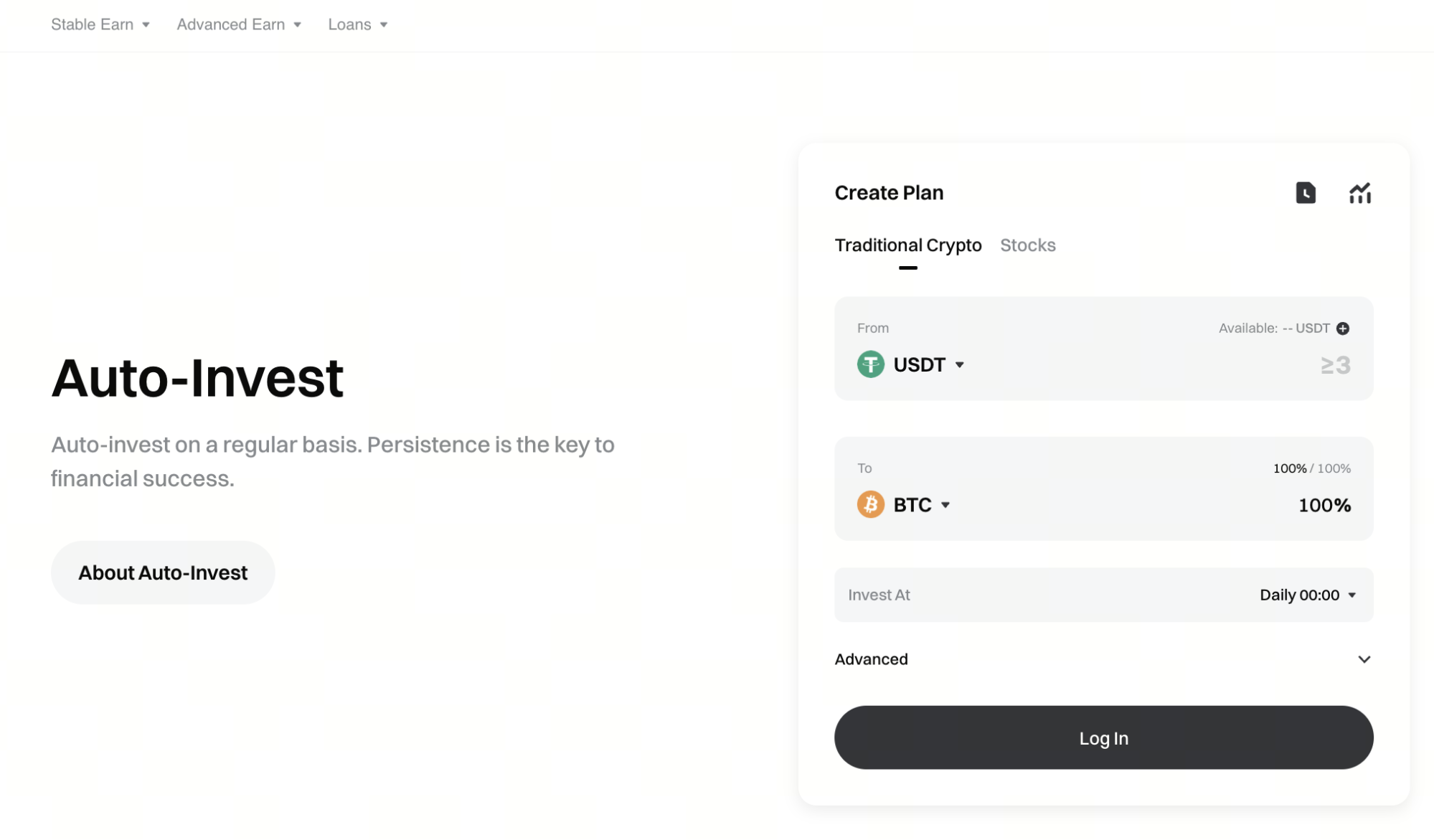
To create a Gate Auto Invest plan, select the payment currency, investment amount, target cryptocurrency, and purchase frequency, then confirm the plan.
Step 1: Open Gate Auto Invest
On the Gate website or app, navigate to the Finance section and select Auto Invest.
The exact interface may change over time, so refer to the current Gate interface if menu labels differ.
Step 2: Choose Your Payment Currency and Amount
Select the supported currency you want to use for recurring purchases and enter the amount to invest each period. Some investors cap DCA contributions at around 5-15% of monthly income.
Available payment currencies, minimum investment amounts, and product access may vary depending on the asset, account type, and region. Because investing involves risk, only invest money from discretionary income.
Step 3: Select the Cryptocurrency
Choose the cryptocurrency you want to purchase through Auto Invest.
Supported assets can change over time as Gate adds or removes eligible cryptocurrencies. Many users apply DCA to established cryptocurrencies such as Bitcoin and Ethereum before considering smaller crypto assets. Gate may also offer featured portfolios that allow users to follow predefined asset allocations instead of creating every allocation manually.
Step 4: Choose an Investment Frequency
Gate supports several recurring schedules:
| Frequency |
How It Works |
| Hourly |
Purchases occur at hourly intervals |
| Daily |
Purchases occur once per day |
| Weekly |
Purchases follow a recurring weekly schedule |
| Biweekly |
Purchases occur every two weeks |
| Monthly |
Purchases follow a recurring monthly schedule |
Choose the schedule that best matches how frequently you want to allocate funds rather than trying to predict which frequency will generate the highest return.
Step 5: Review and Confirm the Plan
Before creating the plan, review:
Confirm the plan once the settings are correct.
Step 6: Monitor or Manage the Plan
Gate lets users view active and historical Auto Invest plans from the Auto Invest portfolio or investment-management area.
Depending on the available settings, users may be able to adjust the investment amount, allocation, or frequency, add funds, or terminate the plan.
Stopping an Auto Invest plan stops future recurring purchases. It does not automatically sell crypto already accumulated through completed purchases.
What Is Dollar-Cost Averaging in Crypto?
Dollar-cost averaging, or DCA, is a strategy of investing a fixed amount at regular intervals regardless of the current price or short-term market prices.
Instead of investing a large amount at one price, DCA spreads purchases over time.
For example, rather than investing $1,200 in Bitcoin immediately, an investor might allocate $100 per month for 6 months.
When the price is lower, the same $200 buys more BTC. When the price is higher, it buys less.
The strategy does not attempt to identify the exact market bottom. Instead, it reduces dependence on making one large investment at a single entry price, which can help reduce analysis paralysis by removing the need to pick one exact entry point in the crypto market.
How DCA Works
Suppose an investor purchases $100 of an asset at three different prices:
| Purchase |
Asset Price ($) |
Amount Invested |
Units Purchased |
| 1 |
50,000 |
$100 |
0.002 |
| 2 |
40,000 |
$100 |
0.0025 |
| 3 |
60,000 |
$100 |
0.001667 |
| Total |
— |
$300 |
≈0.006167 |
The average acquisition cost is approximately:
300/0.006167 ≈ 48,649 per unit
This demonstrates how a fixed-dollar strategy purchases more units when prices are lower. During market volatility, this averaging effect can sometimes lead to better average positioning than making one purchase at a single starting price.
However, DCA does not always produce a lower average acquisition price than investing a lump sum. The final result depends on how the asset’s price changes over the investment period.
What Are the Benefits of Dollar-Cost Averaging?
The main advantage of DCA is reducing dependence on a single purchase date.
Spreads Entry Timing
Instead of investing all available capital at one price, DCA creates multiple entry points.
This can reduce the impact of committing capital at market peaks with one large purchase immediately before a market decline.
Creates a Consistent Investment Process
A predefined schedule supports regular investments and a more systematic approach, reducing the need to make a new timing decision before every purchase.
This may help investors avoid emotional decision-making, since investing small amounts regularly can reduce stress during market fluctuations instead of prompting repeated decisions based purely on short-term fear or excitement.
Buys More Units When Prices Are Lower
With a fixed investment amount:
Lower price → more units purchased
Higher price → fewer units purchased
When price drops, the same fixed amount buys more units, potentially lowering the average purchase price over time.
This is a mechanical feature of DCA, not a guarantee of future performance.
Can Be Automated
Gate Auto Invest enables automated purchases and recurring buys for this process.
Instead of manually placing a purchase according to a calendar, users configure the investment amount and frequency in advance, which can support consistent investments and disciplined investment habits over time.
What Are the Limitations of DCA?
DCA reduces entry-timing concentration, but it does not remove investment risk.
DCA Can Underperform in Rising Markets
If an asset rises steadily after the initial investment date, DCA may underperform in a consistently rising market or strongly trending bull market because an investor who deployed the full amount earlier may earn a higher return as more capital was exposed to the price increase sooner.
A DCA strategy keeps part of the available capital out of the market until later purchase dates.
DCA Does Not Guarantee a Lower Average Cost
DCA is sometimes described as a strategy that automatically lowers an investor’s average purchase price.
That is not always true.
If every subsequent purchase takes place at a higher price, the average acquisition cost will also rise.
DCA simply creates an average based on the prices encountered during the investment period.
Repeated Purchases Can Incur Trading Fees
Gate Auto Invest does not charge a position-management fee, but recurring purchases can still incur applicable trading fees.
Because fee schedules, account-level discounts, and promotions can change, users should review the fees shown in the Gate interface when setting up or managing a plan.
Crypto Price Risk Remains
DCA cannot prevent losses if the cryptocurrency being purchased falls significantly in value.
Automating a purchase schedule does not make the underlying asset less highly volatile or less risky, especially in the broader crypto market.
Why Use Gate Auto Invest Instead of Buying Crypto Manually?
Gate Auto Invest automates the timing and execution of recurring purchases that would otherwise need to be placed manually.
| Manual DCA |
Gate Auto Invest |
| User remembers each purchase |
Purchases follow a predefined schedule |
| Amount entered manually each time |
Amount configured in advance |
| Timing decided repeatedly |
Frequency is predefined |
| Requires repeated order placement |
Recurring execution is automated |
| Records may need manual tracking |
Plans can be viewed in one Auto Invest interface |
Automation can help both beginners and experienced traders maintain a long-term position without reacting to short-term market movements.
Automation can make a DCA strategy easier to maintain consistently.
However, it does not improve the quality of the underlying investment automatically. Users still need to decide which assets, amounts, and schedules are appropriate for their own circumstances.
How to Build a DCA Plan With Gate Auto Invest
There is no universally optimal DCA amount, asset, or frequency.
A useful plan begins with several practical decisions.
Choose the Investment Amount
Select an amount that can be allocated consistently without relying on short-term price predictions.
The appropriate amount depends on factors such as available capital, financial obligations, discretionary income, risk tolerance, and overall portfolio exposure. It should also reflect your financial goals and not require using funds needed for essential expenses.
Choose the Frequency
More frequent purchases create more entry points, but they do not automatically produce better returns.
| Schedule |
Potential Advantage |
Consideration |
| Hourly |
Very granular entry distribution |
High transaction frequency |
| Daily |
Frequent exposure across price movements |
More recurring transactions |
| Weekly |
Simple recurring schedule |
Fewer entry points |
| Biweekly |
Can align with certain cash-flow cycles |
Wider gaps between purchases |
| Monthly |
Easy to manage |
Larger price changes can occur between purchases |
Choose the Asset or Portfolio
Evaluate the underlying cryptocurrency independently from the DCA strategy, and do your own research on the asset before using this approach.
Factors to consider may include:
DCA does not transform a high-risk asset into a low-risk investment, and some crypto investors prefer it for established assets while very small or highly volatile tokens require extra caution.
Review the Plan Periodically
Automation should not mean ignoring the portfolio indefinitely.
Review whether:
-
the asset still fits the original investment objective;
-
the recurring amount remains appropriate;
-
overall crypto exposure has changed significantly;
-
fees materially affect the strategy;
-
the purchase frequency still makes sense.
Plans may need adjustment as financial goals or crypto portfolio exposure change.
Gate Auto Invest vs. Lump-Sum Investing
Auto Invest spreads purchases across multiple dates, while lump-sum investing puts available capital into the market at once. Neither approach consistently outperforms the other in every market environment.
Comparing DCA with a lump sum investment depends partly on risk tolerance, available capital, and the investor’s preferred investment strategy.
| Factor |
DCA / Auto Invest |
Lump Sum |
| Entry timing |
Multiple entry points |
One primary entry point |
| Market exposure |
Gradual |
Immediate |
| Timing concentration |
Lower |
Higher |
| Rising market |
Can lag as capital enters gradually |
Can benefit from earlier exposure |
| Falling market |
Later purchases occur at lower prices |
Full amount is exposed from the initial price |
| Automation |
Can be automated |
Usually a one-time decision |
| Transaction frequency |
Higher |
Usually lower |
For Example
Suppose an investor has \$1,500 available.
If the asset rises continuously, the lump-sum approach generally benefits from purchasing more units earlier at lower prices.
If the asset falls after the first month and later recovers, the DCA strategy has additional opportunities to purchase at lower prices.
The better outcome depends on the actual price path, which is why DCA may feel more appealing during market downturns or a bear market.
By contrast, investors with substantial capital and high risk tolerance may still prefer immediate deployment.
Practical Gate Auto Invest Examples
The following examples are hypothetical and illustrate how recurring purchases work. They do not predict future returns.
Example 1: Weekly BTC Auto Invest
An investor configures: 100 USDT of BTC every week
After 52 successful purchases, the nominal amount allocated would be: 5,200 USDT before applicable fees.
The final BTC amount and average acquisition cost depend on the BTC price at each execution.
Example 2: BTC and ETH Plans
A user could maintain separate recurring plans for BTC and ETH or use available portfolio functionality where suitable.
If BTC and ETH perform differently over time, the portfolio’s actual allocation may drift from the original target. Periodic review can help users understand how their exposure has changed.
Example 3: Higher-Volatility Altcoin
A user may choose an eligible altcoin instead of BTC or ETH.
The recurring-purchase mechanics remain the same, but the risk profile can be substantially different.
If the altcoin experiences a sustained decline, recurring purchases increase exposure to the declining asset. A DCA crypto strategy should therefore not replace research into the asset itself, especially when the asset is highly volatile.
Common Mistakes When Using Gate Auto Invest
| Mistake |
Why It Matters |
| Assuming DCA guarantees profit |
It does not protect against sustained market declines |
| Assuming DCA always lowers cost |
Average cost depends on the actual sequence of prices |
| Ignoring trading fees |
Repeated transactions can affect net results |
| Buying an asset only because its price fell |
Falling prices do not necessarily indicate value |
| Creating too many overlapping plans |
Portfolio exposure can become difficult to monitor |
| Insufficient payment balance |
Scheduled purchases may not execute successfully |
| Never reviewing the strategy |
Market conditions and personal circumstances can change |
| Confusing automation with risk management |
Automation controls execution, not investment risk |
Stopping purchases simply because prices fall can also change a systematic DCA strategy into a market-timing strategy.
At the same time, investors should not continue buying an asset blindly if the original reasons for holding it have materially changed.
How Gate Auto Invest Fits Into Gate Earn
Gate Auto Invest focuses on accumulating crypto over time, while Gate Earn products are designed to generate potential rewards or interest from eligible assets already held.
These products serve different purposes:
| Gate Product |
Primary Purpose |
| Auto Invest |
Automatically accumulate supported crypto at recurring intervals |
| Simple Earn |
Allocate eligible idle assets to Flexible or Fixed Term earning products |
| Soft Staking |
Earn rewards on eligible holdings while maintaining greater flexibility |
| Staking |
Participate in supported staking products |
| Dual Investment |
Use a structured product linked to an asset and target price |
A user may, for example, accumulate an eligible cryptocurrency through Auto Invest and later evaluate whether that asset is available in Gate Simple Earn.
Simple Earn includes Flexible and Fixed Term products with estimated APRs that vary by asset and market conditions.
However, Auto Invest does not automatically generate interest on purchased assets. Auto Invest and Gate Earn are separate products with different mechanics, eligibility requirements, liquidity conditions, and risks.
A simple way to understand the relationship is:
Auto Invest → accumulate assets over time
Gate Earn → evaluate whether eligible idle assets can generate additional rewards
Users should assess each product separately based on current terms, rates, redemption conditions, and risk.
Gate Auto Invest Fees
Gate Auto Invest does not charge a position-management fee, but recurring transactions may still incur applicable trading fees.
The actual cost can depend on the user’s account, fee tier, applicable discounts, and active promotions.
Before confirming a plan, review the current Gate Earn fee information displayed on Gate.
Is Gate Auto Invest Suitable for Beginners?
Gate Auto Invest can simplify recurring crypto purchases for beginners and experienced investors alike because users define the asset, amount, and schedule in advance instead of placing each purchase manually.
This can make the execution process easier for users who prefer a systematic investment approach. DCA can also reduce analysis paralysis by turning recurring investing into a predefined process.
However, automation does not reduce the underlying risk of cryptocurrency investing.
Users should still understand:
-
which asset they are buying;
-
how much is being invested;
-
how often purchases occur;
-
applicable fees;
-
how to modify or stop the plan;
-
the possibility of losing part or all of the invested capital.
Auto Invest simplifies execution. It does not make crypto investing risk-free.
Final Thoughts
Gate Auto Invest is an automation tool for recurring crypto purchases based on the principles of dollar-cost averaging. It is one crypto investing strategy, not a complete plan by itself.
Its main advantage is consistency. Instead of making a new decision every time the market moves, users can create predefined recurring-purchase rules. In practice, DCA helps users stay disciplined during market volatility, but it should still fit a long-term strategy and overall financial goals.
Its limitations are equally important: DCA cannot determine whether an asset is a good investment, guarantee a lower average purchase price, or prevent losses.
For users who later want to explore ways to potentially earn on eligible accumulated assets, Gate’s broader Earn ecosystem—including Simple Earn, Soft Staking, and more—offers separate products that can be evaluated based on their current rates, liquidity conditions, product terms, and risks.
FAQ
How do I create a Gate Auto Invest plan?
Open Auto Invest, choose the payment currency, amount, target cryptocurrency or portfolio, and investment frequency, then review and confirm the plan.
How often can Gate Auto Invest buy crypto?
Gate currently supports recurring frequencies including hourly, daily, weekly, biweekly, and monthly schedules.
Does Gate Auto Invest guarantee profit?
No. Auto Invest automates recurring purchases but does not protect against crypto price declines or guarantee investment returns.
Does DCA always lower your average purchase price?
No. The final average acquisition cost depends on the prices at which each purchase occurs. If prices continually rise, later purchases will take place at progressively higher prices.
Is DCA better than lump-sum investing?
Neither approach is universally better. DCA spreads entry timing, while lump-sum investing provides immediate market exposure. Their relative performance depends on how the asset’s price changes after the initial investment date. Lump-sum investing may appeal more to investors with substantial capital or a high risk tolerance, while DCA is often used for regular investments.
Does Gate Auto Invest charge fees?
Gate does not charge a position-management fee for Auto Invest, but recurring trades may still incur applicable transaction fees. Check the current fee information in the Gate interface before creating a plan.
Can I stop a Gate Auto Invest plan?
Yes. Users can manage or terminate active Auto Invest plans. Stopping the plan prevents future scheduled purchases but does not automatically sell crypto already accumulated.
What happens if there is not enough balance for an Auto Invest order?
A scheduled purchase requires sufficient eligible payment currency. If the required balance is unavailable, the order may not execute as planned. Users should review plan status and transaction history to confirm successful purchases.