The workflow below assumes basic familiarity with calls, puts, and expiry. For product rules, settlement, and quote mechanics, start with Gate crypto options. If the choice is between derivatives formats, compare Gate options vs futures vs event contracts before committing size. Directional hedging with puts or calls follows the same order path described here; see how to hedge BTC with Gate options for hedge-oriented contract selection.
Key Takeaways
- Eligibility, KYC level, and regional availability for crypto options on Gate may differ; the trading UI blocks ineligible accounts before order entry.
- T-quotes show USDT-denominated premiums; contract codes follow a
Market-YYMMDD-Strike-C/P pattern (call or put at a listed strike for a listed expiry).
- European options on Gate do not support early exercise; closing an open position requires an offsetting trade in the market before expiry, unless the position expires worthless or is cash-settled in-the-money.
- Order types include limit and market tickets, IV orders that quote by implied volatility, and advanced time-in-force flags such as Post Only, IOC, and FOK where the interface exposes them.
- Buyers pay premium from USDT balance; sellers face margin requirements that move with underlying price and volatility—monitor margin and liquidation warnings alongside P&L.
What Do You Need Before Trading Gate Options?
Account readiness comes first. Gate options access typically requires a logged-in account that passes the platform’s identity and compliance checks; exact KYC tiers and supported countries can change, so treat “available in my region” as something to confirm inside the live product page rather than assumed from third-party lists. Enable or review any options- or derivatives-specific agreements or risk questionnaires the UI presents before the first order.
Funding uses USDT for quoted premiums and settlement on USDT-margined crypto options. Keep spare USDT beyond the quoted premium if selling options, because short positions consume margin that expands when volatility or adverse moves increase risk. Note the contract multiplier on each underlying—per Help, the Bitcoin options multiplier is 0.01 (one contract controls 0.01 BTC; minimum order quantity in BTC units is 0.01); always confirm multiplier and tick size on the contract you select.
Practice before live size helps. Per Gate Help, simulated trading uses platform-provided demo funds with the same interface as live trading (labeled Simulated Trading) and involves no real costs—use it to walk through T-quote navigation, order confirmation, and position tabs. Simulated trading does not remove live eligibility or regional restrictions. The same workflow appears on the Gate mobile app and on desktop web; product information screens, contract specs, and risk disclosures should match across the mobile app and web before you place size. When you open the mobile app, confirm you are on the official Gate mobile app build, then locate Options under the trade menu so the mobile app T-quote matches the contract code you researched on desktop.
| Prerequisite |
Why it matters |
| Eligibility / KYC |
Blocks order routing if incomplete |
| USDT balance |
Pays buyer premium; supports seller margin |
| Multiplier & tick |
Converts premium USDT to economic exposure |
| Risk settings |
Margin calls and auto-deleveraging affect shorts |
How Do You Read the T-Quote and Choose a Contract?
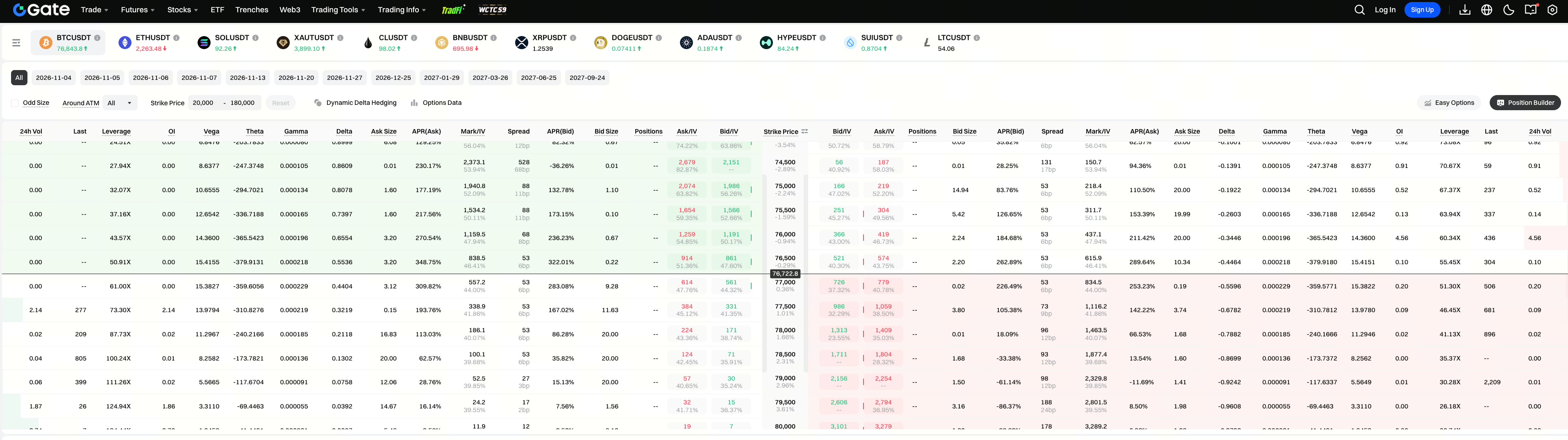
The T-quote board lists tradable strikes and expiries for each crypto underlying Gate supports in options. Each row shows call and put premiums in USDT, often alongside implied volatility and greeks-style fields depending on the terminal layout. Pick expiry first (date in the contract code), then strike, then side: C for call, P for put.
Contract naming follows a compact code such as BTC-250328-90000-C: underlying market, expiry encoded as YYMMDD, strike price, and option type. That code is the handle used in orders, position lists, and history exports—match it exactly when reviewing fills. Compare adjacent strikes and tenors when learning; wide bid–ask spreads on far OTM strikes are normal and affect market-order slippage.
European structure matters at selection time. Because early exercise is not available, a long ITM call cannot be exercised into spot before expiry; profit taking relies on selling the option back or holding through cash settlement. For protective hedges, align expiry with the risk window (e.g., payroll of BTC sales next month) rather than picking the cheapest weekly by premium alone.
How Do You Place Limit, Market, IV, or Advanced Orders?
Open the order ticket from the T-quote row or the contract detail page. Confirm direction (buy to open / sell to open, or close an existing line), quantity in contracts, and the displayed USDT premium or margin estimate.
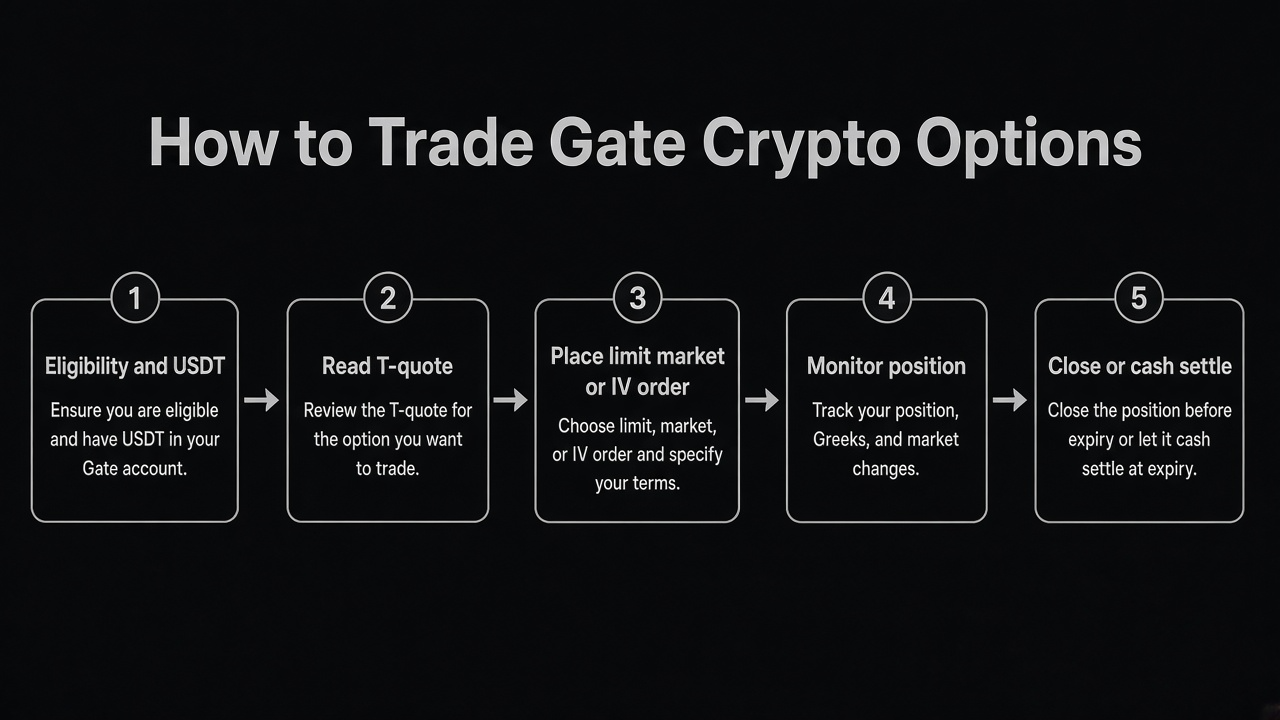
Figure 1. Gate crypto options workflow: prepare → read T-quote → order → monitor → close or settle.
Limit orders fix the maximum premium paid (buy) or minimum received (sell). They rest in the book until filled or canceled; use limits when the spread is wide or when entering around a specific implied vol level.
Market orders prioritize immediate execution against resting liquidity. They suit small test sizes; on illiquid strikes, check the depth preview and expect partial fills or worse average price than the last trade.
IV orders express price in implied volatility terms rather than a raw USDT bid. The matching engine translates IV into a premium using the platform’s pricing model for that contract. IV tickets help when comparing two strikes with different moneyness but a vol view in mind.
Advanced instructions—where enabled—include Post Only (maker-only, reject if would take), IOC (immediate-or-cancel remainder), and FOK (fill-or-kill entire size). These map to common exchange semantics: Post Only avoids taker fees and accidental crosses; IOC and FOK control partial-fill behavior in fast markets.
After submit, verify the open order tab and the positions tab separately. A filled buy shows long contracts and premium debited; a sell-to-open shows short contracts with margin allocated. Closing reverses the side: sell to close a long, buy to close a short, using the same order-type toolkit.
How Do You Monitor Positions and Close Before Expiry?
The positions view aggregates open contracts by underlying, showing average entry premium, mark, unrealized P&L in USDT, and time to expiry. Watch days-to-expiry: theta accelerates into the final days for long premium positions, while short premium faces gamma and pin risk around popular strikes.
Closing before expiry is the standard exit for European crypto options on Gate when physical delivery is not part of the product. Submit an offsetting order on the same contract code; partial closes are supported if quantity allows. At expiry, out-of-the-money contracts expire worthless and the buyer loses the premium; in-the-money contracts cash-settle per Help (difference between market price and strike × contract multiplier), crediting or debiting USDT—details appear in product help and the Gate crypto options explainer.
Set calendar reminders for expiries where you hold short gamma or short vega structures. Auto-settlement removes the need to exercise, but it does not remove the need to manage margin through the last hour if the underlying moves sharply.
What Common Errors Happen and How Do You Fix Them?
| Symptom |
Likely cause |
Fix |
| Order rejected at submit |
Insufficient USDT or margin |
Add USDT; reduce size; close other margin users |
| “Not available” on options tab |
Region / KYC / product gate |
Complete verification; check supported jurisdictions |
| Cannot find contract |
Wrong date or delisted expiry |
Filter T-quote by underlying; pick active series |
| Bought wrong side (C vs P) |
Mis-click on quote row |
Close immediately with offsetting market/limit if needed |
| Position still open after intended exit |
Partial fill or open order not canceled |
Check open orders; flatten remaining qty |
| Unexpected loss near expiry |
Short option cash settlement |
Read Help cash-settlement rules; close earlier |
Confusing contract codes is a frequent beginner error: the strike sits in the middle of Market-YYMMDD-Strike-C/P; transposing date and strike sends orders to a different instrument. Another pitfall is treating European options like American spot options—there is no early exercise escape hatch if the underlying gaps through your short strike; risk control is pre-expiry trading or defined-risk structures.
Is Trading Crypto Options on Gate Safe? Key Risk Checks
Safety here means understanding platform, product, and position risks—not a guarantee of profit. Per Gate Help: buyers generally limit loss to premium paid (plus fees); sellers post IM/MM and can face liquidation—and losses larger than premium collected—if the underlying moves sharply and margin is insufficient.
Run through these checks before repeating size:
- Eligibility truth: Confirm live access under current KYC and region rules; policies change.
- Premium vs margin: Buyers cap loss at premium paid; sellers need ongoing USDT margin and should read liquidation behavior in help docs.
- Liquidity: Wide spreads increase effective cost; prefer limits on thin strikes.
- European expiry: Plan exits; do not rely on early exercise.
- Concentration: Large short vol or short gamma near expiry concentrates settlement risk.
- Operational: Use official apps and URLs; phishing sites mimic derivatives dashboards. Prefer the official Gate mobile app store listing and verify domain information before logging in.
- Cross-device checks: Compare margin and premium information on the mobile app with the web ticket; if the mobile app shows a different multiplier or expiry timezone, pause and re-read the contract information panel.
Gate’s educational materials frame options as advanced products. Pair this how-to with scenario planning (hedge or speculation) in how to hedge BTC with Gate options and format choice in Gate options vs futures vs event contracts. Keep a short checklist of settlement information and mobile app order-confirm screenshots for your own records when learning the ticket flow.
Summary
Trading crypto options on Gate flows from eligibility and USDT funding through T-quote contract selection (Market-YYMMDD-Strike-C/P), order entry via limit, market, IV, or advanced Post Only / IOC / FOK instructions, and active monitoring until an offsetting close or cash settlement at European expiry. Buyers pay premium; sellers post IM/MM scaled by the contract multiplier (Bitcoin options: 0.01)—always verify live contract specs. Simulated trading documented in Gate Help uses demo funds with the same interface as live trading (labeled Simulated Trading).
Treat each order as a commitment through expiry unless closed: European style removes early exercise but not market risk. Keep contract codes, multiplier, and Help cash-settlement rules visible while learning the workflow.
FAQ
Do I need KYC to trade crypto options on Gate?
Gate typically requires identity verification and product eligibility before live crypto options access. Required KYC levels and supported regions can vary and may change; the trading interface shows whether your account can route options orders.
What does the Gate options contract code mean?
Codes follow Market-YYMMDD-Strike-C/P: underlying, expiry date, strike, and call (C) or put (P). Premiums on the T-quote board are quoted in USDT for standard USDT-margined crypto options.
Can I exercise Gate crypto options early?
No. Gate crypto options are European style, so early exercise is not supported. To exit, place an offsetting trade in the market before expiry, or hold through cash settlement if the contract finishes in the money.
What is an IV order on Gate options?
An IV order submits price as implied volatility instead of a fixed USDT premium. The platform converts IV into a premium for matching; use it when the trading plan is vol-based rather than a specific dollar premium.
Is there simulated trading for options on Gate?
Yes. Per Gate Help, simulated trading lets users trade options with system-provided demo funds on the same interface as live trading (labeled Simulated Trading), with no real costs. Live eligibility and regional rules still apply when switching to real trading.