This guide fits beginners who just created a self-custody wallet—or who only “backed up” a photo in a phone album. A seed phrase is BIP-39 seed material and equals root control of the address; a failed backup or a leaked key both end in loss of control. The flow sits on the signing-power model in crypto wallet security: once a seed is compromised, there is no password reset—only migration to a new seed. The sections below cover accurate handwriting, offline multi-location storage, zero/tiny-balance dry-run recovery, and leak response; signing-time risks are covered by wallet phishing checks.
Key Takeaways
- Write the seed phrase offline on paper or metal, in full word order; never back it up via screenshot, cloud drive, email, or chat.
- Keep at least two physical copies in different locations; treat theft of any complete copy as a seed leak and migrate funds.
- Before moving a meaningful balance, complete one full recovery dry-run with zero or tiny funds and confirm the address matches.
- An optional BIP-39 passphrase (often called the “25th word”) adds isolation—but forgetting it permanently loses the key.
- A lost device is usually recoverable; a lost only backup or a leaked seed cannot be restored by customer support.
What Do You Need Before You Start?
Before starting, prepare blank paper or a metal backup plate, two pens in different colors, and a cryptocurrency wallet or hardware wallet that can run offline; the wallet software will usually automatically generate the seed phrase during setup, and you’ll also want a second clean environment for the recovery dry-run. Do not plan a shortcut that is only “take one photo and save it to cloud storage.”
Confirm the wallet supports BIP-39 mnemonics. BIP-39 is a Bitcoin Improvement Proposal, and the bip39 standard defines the wordlist, the entropy-to-mnemonic mapping, and the checksum that most wallets use; the mnemonic phrase is a human readable recovery phrase, not a set of random words to memorize manually. Copy errors often fail recovery because of wrong order or a failed checksum. If assets already sit under an old seed, plan “new-seed dry-run → verify → then migrate,” and keep the dry-run environment isolated from everyday hot wallets so the seed is never typed into a phishing page.
Step 1: How Do You Record the Seed Phrase Accurately?
Accurate recording means the seed phrase works as the master key for the entire wallet, deriving the private keys tied to its wallet addresses, so the word order, spelling, and word count must match the screen exactly—and the medium stays offline the whole time. When the phrase is generated, turn off unrelated cameras and screen sharing; in a private space, copy words one by one from number 1 to N (commonly 12 or 24 words, which form the full word phrase and must be copied in the correct order), then recheck against the original screen with the second pen.
Do not photograph the phrase, paste it into notes apps or a password manager, or keep any digital copy in digital storage or synced to iCloud / Google Drive, Google Photos, or other cloud services—digital copies spread through device backups and cloud indexing. Bitcoin.org’s wallet security guidance treats offline backup as a baseline: a seed should not exist in a remotely readable form. If the client offers a word-order check after copying, finish that check before closing the display. Prefer a metal plate where moisture or fire risk is high; Trezor’s seed backup guidance likewise stresses that a seed should appear only on offline media and never in a web form, and a written seed phrase on metal can survive fire better than a paper backup alone.
Step 2: How Do You Store Backups Offline in Separate Locations?
The executable offline split-storage rule is: at least two physical copies × two different locations × treat removal of any complete copy as a leak. The goal is to avoid single-point failure from fire, theft, or forgetting one place.
-
Two complete copies: Primary and secondary backups must share the same word order; do not split “half the words in A, half in B”—a half copy cannot restore, and assembling both halves still equals a full leak.
-
Location isolation: For example home and office, or home and a trusted safe; the two sites should not share the same simultaneous-damage risk.
-
Banned media: Cloud drives, email, messaging apps, plaintext password managers, and browser bookmarks.
-
Contact triggers review: If anyone else has touched a complete backup, treat it as a potential leak.
-
Passphrase: If a BIP-39 passphrase is enabled, store it separately from the mnemonic; keeping both in the same box removes the extra layer. A wrong passphrase often opens “another empty wallet” with no clear error—recovery looks successful while every address is wrong.
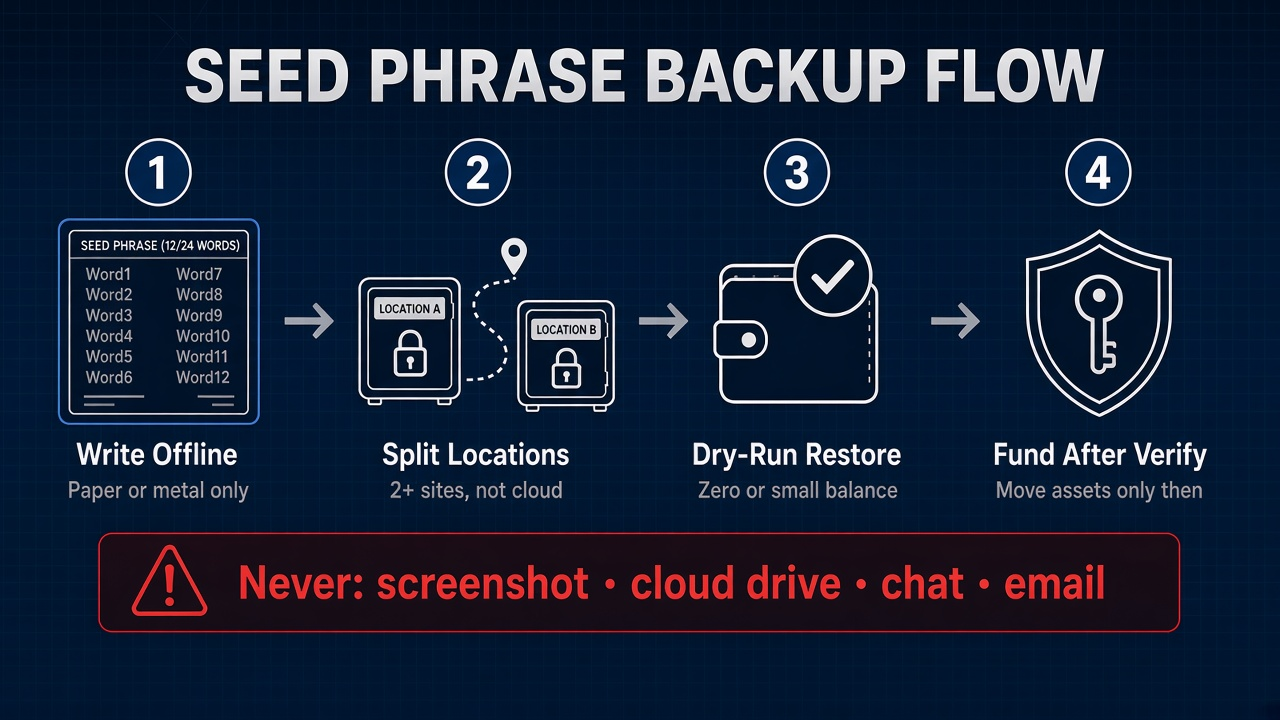 Figure 1. Four-step seed phrase backup flow: handwriting offline, storing copies in separate locations, dry-running recovery with zero or tiny balances, then moving funds only after verification.
Split storage is not “give each person a fragment.” Multiple people each holding a full copy widens the leak surface; each holding a half copy means any single site failure blocks recovery. A more stable pattern is two complete copies under the owner’s control, with a written note of where to retrieve them if needed.
Step 3: How Do You Dry-Run Recovery With Zero or Tiny Balances?
A controlled recovery dry-run verifies—while almost no value is at risk—that the same seed phrase can rebuild the same address set on any compatible device or wallet app before funds move. Skipping the dry-run leaves untested copy errors until a device actually fails.
-
On a clean device, choose “restore with seed phrase” using the handwritten backup—also called the recovery phrase—and restore only in a compatible wallet app (do not look at the original screen or open the photo album).
-
If a passphrase is enabled, enter it per the plan; intentionally mistype once to confirm a different address appears and to learn the failure mode.
-
Compare the first six and last six characters of the restored address with the original address.
-
Optional: send a tiny test amount in and out to confirm the restored private keys can sign transactions.
-
After a pass, clear any temporary plaintext display, then migrate the real balance.
Zero balance suits a first-time setup before funding; with existing assets, create a brand-new seed, finish the dry-run, then migrate. This helps catch human error before real funds are at stake. On failure, recopy against the original screen—do not “fix” words from memory.
Common Mistakes and How to Fix Them
| Mistake |
Cause |
Fix |
| Screenshot / cloud backup |
Treating convenience as security |
Delete cloud copies; switch to handwriting; assess whether to migrate |
| Scrambled order or missing words |
Not copying by numbered slots |
Recopy against the original screen; dry-run recovery again |
| Half-phrase split across two sites |
Believing a split is safer |
Store a complete copy at each site |
| Funding heavily before any dry-run |
Overestimating copy accuracy |
Restore with zero balance; migrate only after addresses match |
| Passphrase stored with the seed |
Saving a step |
Separate locations; record that a passphrase is enabled |
| Sending the seed to support / a webpage |
Phishing pressure |
Stop typing; no legitimate service will ever ask for the seed phrase; migrate to a new seed under the leak playbook |
The first three mistakes are the most common—and the easiest to fix before a device is lost. Once on-chain assets are moved away, a backup process cannot reverse the transfers.
Is Seed Phrase Backup Safe—and What If It Leaks?
A backup verified through offline media, separate locations, and a dry-run lowers the risk of losing keys to device failure or stolen digital copies, and it can help recover access to digital assets or crypto assets after a device failure, but it cannot erase physical risks such as shoulder surfing or coercion. Backup safety equals remotely unreadable media + location redundancy + a leak-migration plan.
If a leak is confirmed or highly suspected (a screenshot once hit the cloud, the phrase was pasted into chat, or it was typed on a connected page):
-
Stop sending funds to the old address.
-
In a clean environment, create a new wallet with a brand-new single seed phrase rather than reusing the old one, then complete handwriting and a zero-balance dry-run.
-
Move assets to the new address as soon as practical; unlimited approvals on the old address remain dangerous too.
-
Retire every copy of the old seed and every wallet instance that used it, because it should now be treated as a compromised wallet.
-
Do not expect a “password change” or support freeze—there is no centralized reset on-chain.
Device lost but backup intact: restore on a compatible device or in one wallet app. Backup also missing: if the only copy is gone and no active device remains, funds may be lost forever. Seed possibly touched by someone else: migrating under the leak playbook is the safer default, because the old wallet should be treated as compromised.
Summary
A repeatable seed-phrase backup flow is: complete offline handwriting → at least two physical sites → zero/tiny-balance dry-run recovery → move funds only after verification. Screenshots and cloud drives turn a seed into a remotely stealable file; half-phrase splits and skipped dry-runs fail exactly when recovery is needed. A passphrase can add isolation, but a wrong entry often has no alarm and forgetting it loses the key. Backup protects “control after the device is gone”; after a seed leak, the only reliable action is migration to a new seed.
FAQ
How should a seed phrase be stored safely?
Keep the full word order as a written seed phrase on a paper backup or metal plate, stored offline and kept out of connected systems; metal is often considered secure because it can better survive fire, place at least two copies in different physical locations, and run one recovery dry-run before funding. The medium must stay offline and free of cloud sync; do not rely on a photo album or chat history, and do not keep the only copy in one place.
Can a seed phrase be backed up with a screenshot or cloud drive?
No. Screenshots, cloud drives, and other digital storage—including Google Photos and similar cloud services—put the phrase into channels that can be backed up, synced, or read by malware. Some online wallets also use seed phrases for recovery, but because they are internet-connected, the backup itself still should not be stored digitally. Even a password manager or notes apps create a digital copy that can be exposed if the account or device is compromised. If that already happened, treat it as a potential leak: delete cloud copies and assess whether to migrate to a brand-new seed.
If a phone or hardware wallet is lost, can a seed phrase still restore access?
Yes. Importing the same mnemonic into a compatible wallet on a new device (plus the correct passphrase, if one was enabled) restores all the private keys and wallet addresses, and the same process works for a bitcoin wallet restored in a compatible wallet app, which also helps if you lose access because of a lost phone or forgotten password. That works only if the backup is complete and has not been taken by someone else; if the backup is also gone, recovery is impossible.
What should happen after a seed phrase leaks?
Immediately stop funding the old address: once a leak happens, anyone with the phrase can recreate the wallet on their own device, so the old wallet must be treated as a compromised wallet. On-chain systems cannot “change the password” to void an old seed. Instead, create a new wallet with a fresh recovery phrase, back it up offline, do a quick dry-run, move assets to the new address as soon as practical, and then retire every copy of the old seed.
Should a seed phrase be split and given to multiple people?
Usually no. Splitting into halves increases recovery risk because any single site failure can block access, while giving full copies to family members increases disclosure risk. shamiR's secret sharing is a more structured alternative, but it makes the recovery process more complex. A more stable pattern is two complete copies under the owner’s control, with a written note of where they are stored if needed.