The AI industry is gradually shifting from competition over model capabilities toward commercialization and real-world industry applications. In the early market, attention typically focused on model parameter size, benchmark performance, and technological breakthroughs. As large models are applied to enterprise services, software development, intelligent customer service, and AI agents, the market is paying closer attention to whether models can generate stable revenue, whether customers are willing to continue paying, and whether companies can control computing and R&D costs while scaling their services.
Zhipu AI is one representative company in this development. Its core business is built around the GLM series of large models and extends to model services, developer platforms, and enterprise applications. After entering the public capital markets, investors need to understand not only AI technology itself, but also assess the company's business model, competitive position, and financial performance.
From the intersection of TradFi and digital asset markets, ZHIPUG/USDT offered through Gate gStocks provides users with an entry point for trading tokenized securities related to Zhipu AI stock. However, changing the form of the trading asset does not change the core requirements for analyzing an AI company's fundamentals. Understanding how model technology translates into revenue, how computing investment affects costs, and how industry competition changes profit margins remains fundamental to analyzing Zhipu AI.
Key Takeaways
-
Zhipu AI's long-term development depends on whether model capabilities, product adoption, customer payments, and cost control can form a sustainable business cycle
-
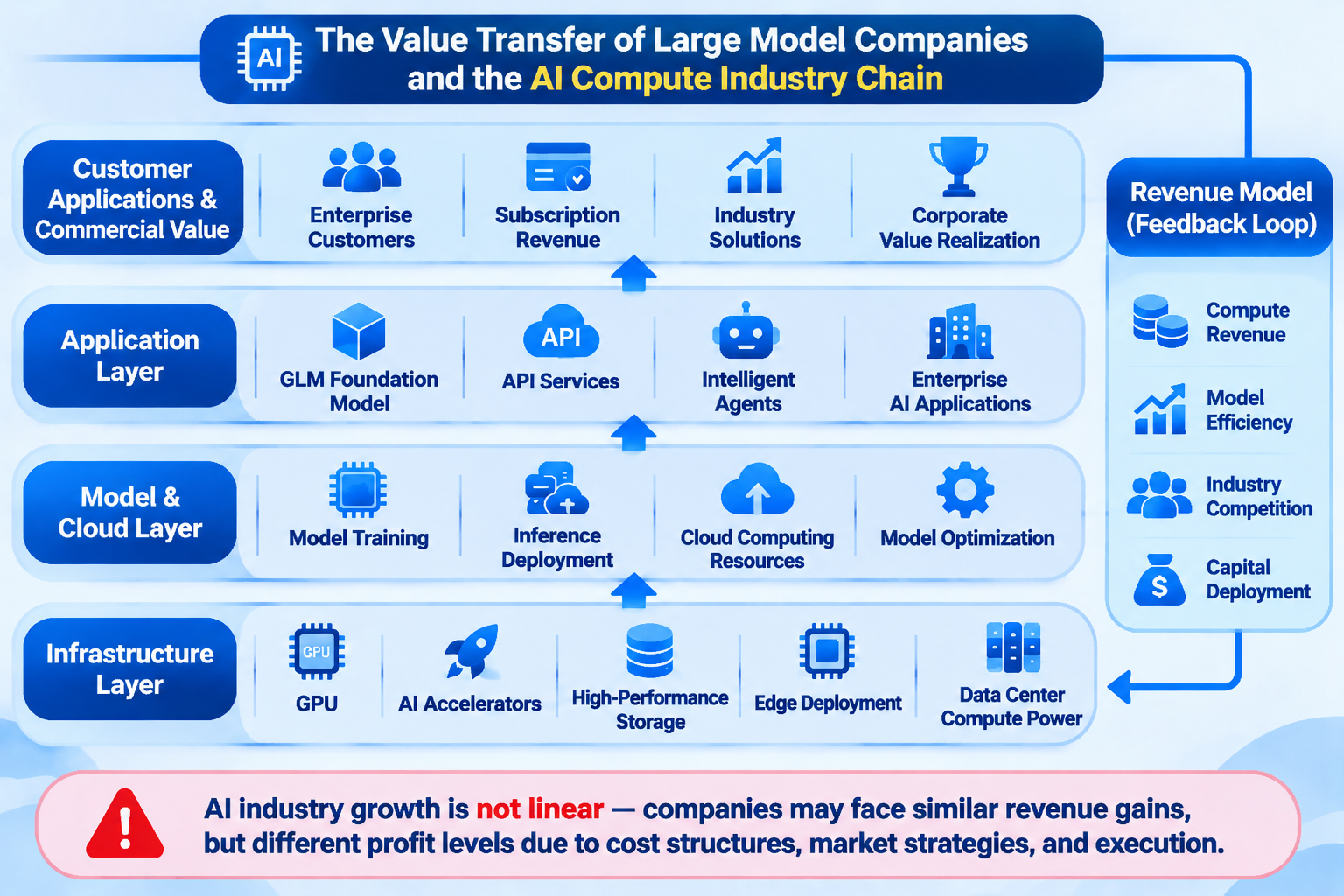
The AI industry chain includes not only model companies, but also GPUs, semiconductors, data centers, cloud services, and power infrastructure. Industry-chain strength does not equal the profitability of any single company
-
ZHIPUG is a tokenized securities trading asset related to Zhipu AI stock. Analysis should consider the company's fundamentals, the performance of the underlying stock, and the trading conditions of the tokenized product itself
Where Does the Value of Large-Model Companies Come From?
The core assets of large-model companies are not limited to any single model version. They also include the combined ability to continuously research, train, deploy, and iterate models. Model architecture, training data, algorithm optimization, inference efficiency, and product engineering together determine whether a model can provide reliable services across different tasks. For enterprise customers, whether a model can genuinely solve business problems is usually more meaningful than its ranking in any single benchmark.
Zhipu AI's GLM series models are an important part of its technology stack. Around its foundation models, the company can further provide APIs, model service platforms, AI agent tools, and industry solutions. Different product forms correspond to different customer groups and revenue models. Developers may pay based on model usage, enterprise customers may purchase customized deployment or comprehensive solutions, and end users may contribute revenue through subscriptions or value-added services.
This means the commercial value of a large-model company needs to be analyzed layer by layer, from technical capabilities to product capabilities and customer value. Strong model performance does not automatically mean that a company can generate high revenue. Product usage also does not necessarily mean that revenue is sufficient to cover training, inference, R&D, and sales costs. Only when customer demand can be consistently converted into paid usage can technological advantages form a more stable commercial foundation.
Therefore, when observing Zhipu AI, attention should be paid to whether model iterations lead to customer growth, whether increased usage leads to revenue growth, and whether the company can improve its unit service costs as it scales its business. Model capabilities are the starting point of competition, while commercialization efficiency determines whether technological advantages can translate into long-term operating results.
Why Is AI Commercialization More Important Than Model Popularity?
AI products typically require multiple stages of commercialization. A company must first demonstrate that its model can complete specific tasks, then integrate it into customers' workflows, and finally monetize it through APIs, subscriptions, private deployment, or industry solutions. Different customers have different deployment environments, data security requirements, and usage frequencies, meaning that commercialization is often not as simple as merely making a model available to users.
For a foundation-model company such as Zhipu AI, potential revenue sources may include model API usage, enterprise-grade model services, AI agent products, and related technology solutions. The API model is highly scalable, but revenue is affected by customer usage, model pricing, and inference costs. Enterprise deployment may generate larger project revenue, but it also requires greater investment in delivery, customization, and after-sales support. Different revenue structures affect a company's gross margin, revenue stability, and expansion efficiency.
When evaluating AI companies, the market can easily treat user numbers, model usage, or product popularity as direct evidence of commercial success. However, these indicators need to be considered alongside paid conversion rates, customer retention, contract size, and collections. Growth in free usage may increase a model's influence, but it may also increase inference costs. Large customer projects can generate revenue, but excessive customization may limit the business's ability to scale through replication.
Therefore, long-term analysis should shift from asking whether a model is attracting attention to asking whether customers are willing to continue paying. If model capabilities continue to improve but revenue growth cannot cover computing and R&D investment, the company may still face significant operating pressure. Conversely, if a company can embed its model capabilities into high-frequency, mission-critical business processes for which customers are willing to pay, the sustainability of its business model is more likely to be validated.
How Do Computing Power and Semiconductors Affect Large-Model Companies?
Both training and inference for large models depend on computing resources. The training phase requires large amounts of GPU or other AI accelerator capacity to optimize model parameters. The inference phase requires ongoing computing resources to respond to user requests. As model size, context length, and user usage increase, computing demand may rise accordingly, prompting companies to increase hardware purchases, cloud service spending, and data center investment.
Semiconductors are therefore an important foundation of the AI industry chain. GPUs, advanced-process chips, high-bandwidth memory, advanced packaging, and high-speed interconnect technologies jointly affect the performance and cost of AI computing systems. Chip supply, equipment delivery timelines, energy costs, and data center construction progress can all affect how quickly large-model companies can expand their service capabilities.
However, rising AI computing demand does not mean that all AI companies will benefit to the same extent. Chip suppliers, cloud service providers, data center operators, and model developers play different roles in the industry chain and have different revenue recognition methods and cost structures. Model companies may reduce inference costs as computing prices decline, but they may also be forced to offer services at lower prices as competition intensifies. The ultimate impact of rising computing demand on profitability must be assessed based on procurement models, resource utilization, and customer pricing power.
When analyzing Zhipu AI, computing power and semiconductors can be viewed as external operating conditions rather than treating semiconductor industry strength as equivalent to the company's performance. Further analysis should examine model inference efficiency, unit usage costs, training investment, cloud resource procurement, and customers' willingness to pay to determine whether the company can convert computing investment into sustainable product revenue.
How Are Competitive Advantages Formed in the AI Industry?
The large-model industry requires substantial technological and capital investment. Companies need to continuously invest in research talent, training infrastructure, data governance, and model security while competing with open-source models, closed-source models, cloud providers, and vertical AI application companies. Differences in model performance may narrow as technology advances, meaning that leadership in a single version does not necessarily constitute a long-term competitive barrier.
Zhipu AI's competitiveness needs to be assessed across multiple dimensions. The first is the overall capability of its foundation models, including language understanding, reasoning, code generation, multimodal processing, and tool use. The second is deployment efficiency and inference cost, which determine whether products can be used at scale in real-world business environments. The third is the developer ecosystem and enterprise customer relationships, which affect model usage frequency and customer switching costs.
Open-source strategy is also an important dimension for assessing how model companies compete. Open models can expand developer adoption, promote ecosystem development, and encourage external innovation, but they may also make model capabilities easier to replicate or replace. Companies need to find a balance among open ecosystems, commercial services, and technological differentiation. Making a model open source does not necessarily indicate a weak business model, nor does it necessarily mean that ecosystem advantages can be directly converted into revenue.
Companies also need to balance R&D speed with operating efficiency. Continuously releasing new models can maintain technological competitiveness, but if R&D costs grow too quickly or new products fail to generate sufficient customer revenue, financial pressure will also increase. Long-term competitive advantages usually come from a combination of technical capabilities, product experience, customer relationships, cost efficiency, and organizational execution rather than from a single technical metric.
How Should Zhipu AI's Operating Quality and Market Valuation Be Evaluated?
Analyzing a publicly listed AI company requires separating industry narratives from financial data. Long-term market expectations for generative AI may drive valuation changes, but a company's actual operating quality still needs to be validated through metrics such as revenue growth, gross margin, R&D expenses, sales expenses, cash flow, and customer composition. For companies that are still in an expansion phase, high R&D investment does not necessarily indicate operating failure. However, investors need to determine whether that investment is generating sustainable technological and commercial returns.
Revenue growth needs to be analyzed alongside its sources and quality. If revenue primarily comes from one-time projects, its repeatability may be limited. If revenue from model services and platform usage increases as a share of total revenue, customer retention, usage frequency, pricing, and gross margin should continue to be monitored. Growth in the number of enterprise customers should also be assessed alongside contract value, renewals, and changes in accounts receivable to avoid equating customer reach directly with stable cash flow.
Valuation also needs to reflect the relationship between future growth and current risks. The market valuation of an AI company may be affected by technological expectations, industry competition, capital market liquidity, and the macro interest rate environment. Even if a company maintains revenue growth, its valuation may still be adjusted if growth falls short of already-high market expectations. Conversely, a short-term decline in market sentiment does not necessarily mean that the company's long-term technological capabilities have fundamentally changed.
When evaluating Zhipu AI, it is therefore useful to establish two observation checklists: operating metrics and market metrics. Operating metrics help assess whether the company can continue generating revenue and improve its cost structure. Market metrics help track stock price, trading volume, valuation changes, and risk appetite toward the industry. The two should be considered together, but neither can replace the other.
How Do Sentiment Toward the AI and Semiconductor Markets Affect ZHIPUG?
AI and semiconductor sectors are generally connected through the industry chain, but stocks from different segments do not always move in sync. When the market expects demand for AI computing power to rise, investors may simultaneously focus on chip design, manufacturing, memory, advanced packaging, cloud services, and large-model companies. However, the timing of benefits, revenue recognition methods, and earnings sensitivity differ across companies.
For Zhipu AI, strength in the semiconductor and computing-power industries can affect the supply conditions for model training and inference resources and may also influence market expectations for overall AI industry growth. However, as a model development and service company, Zhipu's operating performance also depends on model competitiveness, customer payments, product delivery, and cost management. A rise in semiconductor stocks does not directly prove that Zhipu's revenue or profit has improved accordingly.
Market sentiment can also affect the prices of related stocks and tokenized securities through valuation expectations. When favorable AI industry news emerges, investors may adjust their growth expectations for model companies in advance. When the market begins focusing on computing costs, intensifying competition, or commercialization progress, valuations may also change. For ZHIPUG, in addition to observing the market performance of Zhipu AI's underlying stock, investors should monitor trading volume, spreads, and liquidity in the tokenized trading market itself.
When researching ZHIPUG, three levels of observation can therefore be established. First, Zhipu AI's operating and technological progress. Second, supply and demand and capital expenditure changes across the AI and semiconductor industry chain. Third, ZHIPUG's trading conditions on the Gate platform. These three areas are connected, but none can represent the entire investment rationale on its own.
Gate gStocks and ZHIPUG: A Digital Asset Trading Entry Point for AI Stocks
Gate gStocks provides a ZHIPUG/USDT tokenized securities trading entry point for Zhipu AI. Users can view market quotes on the Gate ZHIPUG/USDT trading page and use USDT to participate in related trading. The product connects Zhipu AI's stock performance with the trading environment of a digital asset platform, providing a case study in the digital trading of TradFi and AI assets.
However, ZHIPUG is not an original stock issued by Zhipu AI. It is a tokenized securities trading asset within Gate gStocks. Users should distinguish among the underlying stock price, the reserves and rights arrangements of the tokenized product, and market liquidity on the platform. Holding ZHIPUG should not be understood as directly holding 02513.HK, nor should it be assumed to provide voting rights or dividend rights associated with the original stock.
For participants, analyzing ZHIPUG requires attention to both the company and the product. At the company level, users should track Zhipu AI's model R&D, commercialization revenue, R&D investment, and industry competition. At the product level, they should observe token pricing, trading volume, bid-ask spreads, trading rules, and relevant risk disclosures. Studying these two sets of information separately can help avoid equating AI industry popularity directly with the market performance of tokenized securities.
Building a Long-Term Framework for Observing Zhipu AI
Long-term observation of Zhipu AI can be conducted across five dimensions. The first is technical capability, including iterations of the GLM series models, reasoning capabilities, multimodal performance, and deployment efficiency. The second is commercialization progress, including API revenue, enterprise customers, product payments, and customer retention. The third is the cost structure, including computing procurement, inference costs, R&D expenses, and resource utilization. The fourth is the industry environment, including GPU supply, semiconductor technology, data center construction, and cloud service pricing. The fifth is capital market performance, including the company's financial data, stock valuation, market liquidity, and ZHIPUG's trading conditions.
These dimensions are connected but cannot replace one another. Improved model performance may drive customer adoption but may not immediately generate revenue growth. Lower computing prices may improve inference costs, but if competition forces companies to lower model service prices, profit margins may not expand accordingly. Improved sentiment across the AI sector may raise market valuations, but it cannot replace an assessment of any individual company's operating quality.
Observers should therefore maintain continuous records rather than draw conclusions from a single day's market activity or a single model release. Company financial reports, model updates, enterprise customers, and product changes can be tracked regularly, along with GPU and semiconductor supply, cloud service pricing, and industry capital expenditure. At the market level, the performance of 02513.HK and ZHIPUG trading data should be recorded separately to avoid conflating the prices, trading volumes, and trading hours of the two markets.
Ultimately, long-term analysis of Zhipu AI should return to the operating logic of AI companies: technical capabilities need to be converted into revenue through products and customer demand, revenue needs to cover R&D and computing costs, and industry growth needs to translate into the company's competitive advantages and financial performance. Research on ZHIPUG must also incorporate the mechanisms and trading risks of the tokenized securities product itself. Only by combining the technical, commercial, industry, and market dimensions can a more complete observation framework be formed.
FAQ
What Does Zhipu AI Mainly Do?
Zhipu AI is an artificial intelligence company focused on the development of general-purpose large models. Its business covers the GLM series models, model services, developer platforms, and enterprise AI applications.
What Is Zhipu AI's Stock Code?
Zhipu AI was listed on the Main Board of the Hong Kong Stock Exchange on January 8, 2026, under the stock code 02513.HK.
Why Should the Semiconductor Industry Also Be Monitored When Analyzing Zhipu AI?
Large-model training and inference depend on infrastructure such as GPUs, memory, advanced packaging, and data centers. Semiconductor supply and computing costs affect the R&D, deployment, and service costs of model companies, but industry-chain strength does not directly equal the profit growth of any single model company.
Does Improved AI Model Capability Mean That a Company's Value Will Definitely Increase?
Not necessarily. Model capabilities still need to translate into customer adoption, continued payments, and controllable costs. If R&D and inference costs grow too quickly, or commercialization revenue is insufficient to cover investment, technological progress may not immediately translate into improved operations.
Is ZHIPUG's Price Exactly the Same as Zhipu AI's Hong Kong Stock Price?
It should not simply be treated as exactly the same. ZHIPUG is related to the underlying stock price, but the tokenized product's own supply and demand, liquidity, reference price update frequency, and product mechanisms may also affect its market price.