For crypto users, the distinction becomes even more important because there is another layer to consider: fiat can be deposited through banking or card channels, exchanged for digital assets, transferred through a P2P crypto marketplace, or spent through a crypto-enabled card. The best payment method therefore depends on what you are trying to do, how quickly the money needs to arrive, the transaction size, the available protections, and the total cost rather than simply which method appears fastest.
Key Takeaways
-
Cards are generally best for everyday purchases, subscriptions, travel, and online shopping because authorization occurs quickly and merchant acceptance is broad.
-
Bank transfers are useful for sending money directly between accounts and can be better suited to larger transfers, business payments, and fiat deposits or withdrawals.
-
P2P payment services simplify transfers between individuals, but fees, reversibility, limits, and consumer protection vary substantially between providers.
-
A consumer P2P app such as Zelle or PayPal is not the same thing as a crypto P2P marketplace, where users buy and sell cryptocurrency with each other using supported fiat payment methods.
-
Payment speed and cost should not be generalized. ACH, SEPA, cards, wires, P2P apps, and instant-payment systems all have different pricing and settlement rules depending on the bank and jurisdiction.
Card vs Bank Transfer vs P2P: The Main Differences
The simplest way to distinguish the three methods is by how they are normally used.
A card payment authorizes a merchant to collect payment through a card network and the issuing bank or card provider. The customer experiences the payment almost immediately even though final settlement between financial institutions can occur later.
A bank transfer is generally initiated by the sender. Money moves from one bank account toward another through a domestic or international payment system such as ACH, SEPA, Faster Payments, FedNow, or a bank wire.
A P2P payment service provides a simpler interface for transferring money to another person upon a consented agreement, often using an email address, phone number, username, or QR code rather than manually entering full banking information.
| Factor |
Card |
Bank Transfer |
P2P Payment |
| Best use |
Everyday purchases |
Account-to-account transfers |
Person-to-person payments |
| User experience |
Immediate authorization |
Depends on banking rail |
Often near-instant |
| Transaction size |
Limited by card/account |
Often higher |
Usually provider-specific |
| Recipient information |
Merchant card terminal/account |
Bank details |
Phone, email, handle or QR |
| Purchase protection |
Can be strong, especially credit cards |
Depends on payment type |
Often limited for authorized sends |
| Crypto use |
Crypto purchases or crypto cards |
Fiat funding/cash-out |
P2P crypto settlement |
These are general characteristics rather than universal rules. An instant bank payment can be faster than some card transactions, while a P2P transfer may itself run through a bank account or debit-card rail.
How Card Payments Work
A card is primarily designed for paying merchants rather than transferring money directly between personal bank accounts.
When you use a debit card, funds are ultimately drawn from the associated balance. A credit card instead uses credit provided by the issuer and is repaid later according to the card agreement. Crypto-enabled cards add another variation by connecting digital assets or a crypto-funded card balance with existing payment infrastructure.
When a purchase is initiated, the merchant sends an authorization request through the relevant card network and payment processors. The issuer checks factors such as available funds or credit, fraud controls, and card status before approving or declining the payment.
For users, this process normally feels instantaneous. Final merchant settlement is a separate process and does not need to finish before you walk out of a shop with the purchase.
Cards are therefore especially useful for online shopping, travel bookings, recurring subscriptions, restaurants, retail purchases, and other situations where merchant acceptance and convenience matter.
Debit Cards vs Credit Cards
Debit and credit cards may look similar at checkout, but the underlying risk and funding structure differs.
A debit card generally uses your own available funds. This makes spending easier to control, but disputes can temporarily affect money that would otherwise remain in your bank account.
A credit card uses a credit facility, which can provide an additional separation between fraudulent purchases and the user’s cash balance. Credit-card regulations and issuer policies can also provide dispute and chargeback mechanisms for eligible purchases.
The trade-off is that borrowing can become expensive if the outstanding credit-card balance is not repaid according to the applicable interest-free period and terms.
For either type, foreign-exchange charges vary considerably. It is inaccurate to assume every card charges a 1%–3% FX fee because some cards charge more, some less, and some specifically waive foreign-transaction fees.
Where Crypto Cards Fit In
Crypto cards combine crypto funding with familiar merchant payment infrastructure.
Gate Card, for example, allows eligible users to spend supported digital assets and currently lists assets including USDT, BTC, ETH, and GT for its Instant Spend experience. Gate’s card page advertises up to 8% cashback under its current rewards program.
The exact mechanics depend on the Gate Card program available to the user. Gate operates different regional card structures, so it should not be described as one identical Visa debit card worldwide. Gate US, for example, operates a separate prepaid Visa card program, while Gate’s other card offerings have their own issuer, fee, and eligibility structures.
For users who already hold crypto, the main advantage is convenience: spending can occur without manually selling an asset, withdrawing fiat to a bank, and then paying from a conventional bank card.
However, the real cost should still include any crypto-conversion fee, foreign-exchange fee, ATM fee, spread, and other card-specific charges.
How Bank Transfers Work
Bank transfers move funds directly between financial accounts and are commonly used for salaries, invoices, rent, business payments, brokerage funding, and larger transfers.
Different countries use different systems. In the United States, ACH is widely used for domestic electronic payments, while FedNow and RTP provide faster-payment options through participating institutions. The euro area uses SEPA and SEPA Instant, while the UK has Faster Payments. Traditional wire networks are also used domestically and internationally.
Speed therefore varies considerably. Some instant-payment systems can complete transfers in seconds, while a standard bank transfer or cross-border payment may take longer because of bank processing, currency conversion, compliance screening, time zones, or intermediary institutions.
Bank transfers should not automatically be described as expensive or cheap. Domestic transfers can be free at one bank and fee-based at another. International wires can carry sender, intermediary, receiving-bank, and FX costs, but those costs depend on the particular institutions involved.
When Bank Transfers Make Sense
Bank transfers are particularly useful when the recipient expects money directly in a bank account or when transaction size makes a card impractical.
Examples include business invoices, property-related payments, tuition, investment-account funding, salary payments, or moving fiat into and out of an exchange that supports direct bank integration.
For crypto users in eligible European markets, Gate EU currently supports direct fiat deposits and withdrawals. Users select an available fiat currency and payment method, follow the bank-transfer instructions, and can later withdraw to a bank IBAN that matches their verified identity. However, the actual arrival time varies with the payment method, transfer time, and receiving bank.
This can be more appropriate than a card purchase when the goal is to transfer fiat into an exchange balance first and then choose how and when to trade.
What Are P2P Payment Apps?
P2P payment services reduce the friction involved in paying another person.
Instead of requesting a routing number or IBAN, a service may let the sender select a contact, phone number, email, username, or QR code.
Examples vary by market. Zelle is integrated with participating U.S. banks and sends money directly between eligible bank accounts. PayPal operates across many markets and can support wallet balances, bank transfers, cards, and merchant payments. Regional payment systems and apps can serve similar roles elsewhere.
P2P payment costs also vary too much to state that they are generally cheaper than bank transfers. A free domestic P2P transfer might cost nothing, while card funding, international transfers, currency conversion, or instant withdrawals can introduce fees.
P2P Payments and Reversibility
One of the biggest P2P risks is that an authorized payment can be difficult or impossible to reverse.
Zelle, for example, states that once money has been sent to an already enrolled recipient, the payment cannot be cancelled or reversed. It therefore recommends using the service only with people and businesses the sender knows and trusts.
This does not mean every P2P service has identical rules. PayPal and other platforms may provide different dispute processes depending on whether a transaction is a personal transfer or payment for goods and services.
The broader lesson is that users should not assume P2P transfers have the same purchase protections as credit-card payments.
P2P Payment Apps vs Crypto P2P Trading
These two concepts are frequently confused.
A consumer P2P payment app moves fiat from one person to another.
A crypto P2P marketplace connects a crypto buyer with a crypto seller. The users agree on a fiat payment method while the marketplace provides order matching, escrow, dispute procedures, and other transaction controls.
Gate P2P falls into the second category.
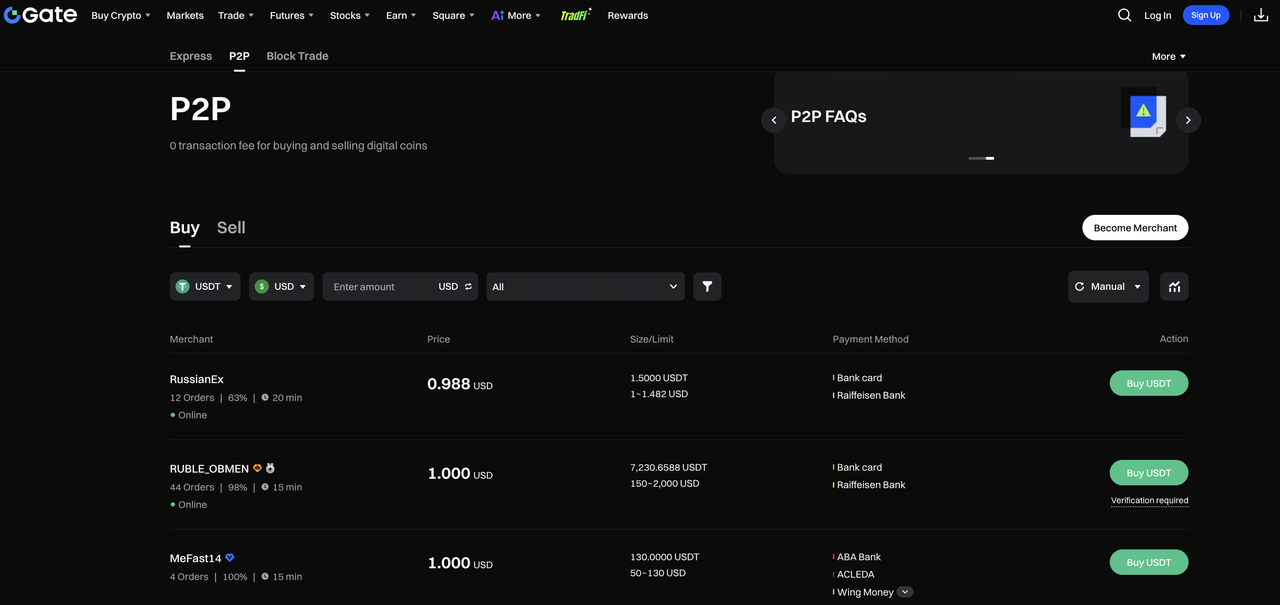
Suppose a user wants to buy USDT. They select a Gate P2P merchant offering USDT for their local currency, initiate the order, make the agreed fiat payment through one of the merchant’s supported methods, and receive the corresponding crypto after payment is confirmed.
Gate’s current merchant rules state that P2P trading fees are temporarily waived for all users. Because Gate explicitly describes the fee waiver as temporary, an evergreen article should say the platform currently charges no P2P trading fee rather than claiming Gate P2P is permanently free.
Card vs Bank Transfer vs P2P: Costs
There is no useful universal fee table for these payment methods because costs are determined by banks, countries, currencies, card issuers, P2P platforms, and transaction types.
A more useful comparison is to identify where costs typically arise.
| Method |
Possible Costs |
| Card |
FX fees, card interest, cash-advance fees, crypto conversion fees |
| Bank transfer |
Bank fee, wire fee, intermediary fee, FX spread |
| P2P app |
Card-funding fee, instant-withdrawal fee, FX fee, merchant fee |
| Crypto P2P |
Exchange/P2P fee, payment-method costs, quoted price spread |
| On-chain crypto |
Network fee, exchange withdrawal fee, conversion spread |
The cheapest method is the one that delivers the highest final amount after all applicable fees and conversion rates.
For example, a stablecoin transaction with a low blockchain fee may initially appear cheaper than SWIFT. But if the sender must first buy USDC, pay a trading spread, withdraw it, and the recipient later pays another spread to convert back into fiat, the end-to-end cost can be higher than the network fee alone suggests.
Comparing Speed and Limits
Speed is similarly dependent on the actual rail.
Cards usually provide immediate authorization for purchases. P2P services can send money within minutes in supported situations. Bank transfers can range from seconds on instant rails to several business days for some cross-border payments.
Limits depend even more on the provider. A bank may allow much larger payments than a consumer P2P app, but an institution can still impose lower limits than the underlying payment system. Card spending is constrained by available funds, credit, fraud controls, and issuer limits.
Instead of using generic numbers, users should check the limits displayed by their bank, card, or payment platform before initiating a significant transaction.
Security and Fraud Risks
Each method offers different protections rather than one being universally safest.
Cards can offer strong protections for unauthorized transactions and eligible merchant disputes, particularly when credit cards are used. Digital wallets such as Apple Pay can also reduce exposure of the underlying card number by using tokenized payment credentials.
Bank transfers benefit from regulated banking infrastructure and account authentication, but authorized push-payment scams remain a serious concern. Once a wire or other irreversible transfer reaches a fraudster, recovery can be difficult.
P2P services are especially vulnerable to social engineering because their speed makes them attractive to scammers. Zelle explicitly warns that it does not offer purchase protection for transactions where users do not receive the item they expected.
Crypto transfers introduce another risk model. Blockchain transactions can normally not be reversed once confirmed, so address verification, network selection, private-key security, and account security become crucial.
Where Gate Fits Into the Payment Flow
Gate users can interact with several of these payment methods depending on jurisdiction.
-
Bank transfer: Gate EU supports eligible direct fiat deposits and withdrawals through banking methods.
-
P2P: Gate P2P allows users to transact with merchants using supported local fiat payment methods, with platform P2P trading fees currently waived.
-
Card spending: Gate Card enables eligible users to spend supported digital assets through its regional card programs and currently offers up to 8% cashback under the global rewards program.
-
Merchant crypto payments: Gate Pay provides crypto payment infrastructure for merchants. Its current API supports orders denominated in either crypto or fiat value, with fiat-denominated orders converted to an equivalent crypto amount using the applicable real-time exchange rate.
These services solve different problems rather than competing directly with one another.
Which Payment Method Should You Use?
For ordinary retail purchases, cards are usually the most convenient because merchants already have established card-payment infrastructure and cardholders may receive additional dispute or rewards benefits.
For larger account-to-account transfers, bank payments can be more appropriate because they are designed for direct movement between financial accounts and generally support higher transaction sizes.
For sending money to someone you know, a P2P payment service can reduce friction and allow quick transfers using simple recipient information.
For buying crypto with local payment methods, a P2P crypto marketplace such as Gate P2P can provide an alternative when direct fiat banking integration is not suitable or available.
For spending crypto, Gate Card can remove the additional step of manually cashing out to a bank before making an everyday card purchase.
For direct blockchain settlement, stablecoins can be useful when both sender and recipient are comfortable remaining within crypto rather than immediately converting back into fiat.
The correct choice depends on the complete payment journey, not only the first transaction.
Conclusion
Cards, bank transfers, and P2P payments are optimized for different types of transactions. Cards excel at merchant payments and everyday spending, bank transfers are suited to direct account-to-account movement and larger payments, while P2P services make person-to-person transfers faster and simpler. None is universally cheaper or safer: fees, limits, settlement times, and dispute rights depend on the specific provider and payment rail.
For crypto users, Gate connects several parts of this payment landscape. Depending on region, users can fund or withdraw fiat through banking channels, buy and sell crypto through Gate P2P, spend supported digital assets with Gate Card, or use Gate Pay for crypto merchant payments. The best option comes down to what you are moving, where it needs to go, how quickly it needs to arrive, and how much protection and control you need along the way.
FAQ
Is a bank transfer safer than a P2P payment?
Not automatically. Bank transfers operate through regulated financial institutions, but authorized bank transfers can still be difficult to reverse. Some P2P services also use regulated banking rails. Security depends on the payment type, provider, recipient, and whether the transaction was authorized.
When should I use a card instead of P2P?
Cards are generally more appropriate for purchases from unfamiliar merchants, online shopping, travel, and situations where purchase or dispute protections matter. P2P transfers are better suited to people you know and trust.
Is P2P payment the same as P2P crypto trading?
No. P2P payment apps transfer fiat between users. Crypto P2P marketplaces connect crypto buyers and sellers and use external fiat payment methods to settle the fiat side of the trade.
Does Gate charge P2P trading fees?
Gate currently states that P2P trading fees are waived for users. Because the waiver can change, users should check current rules before trading.
Can I deposit money into Gate through a bank transfer?
Availability depends on the user’s jurisdiction and Gate entity. Gate EU currently supports eligible fiat deposits and withdrawals using bank-transfer methods.
Are stablecoin transfers always cheaper than international bank transfers?
No. Blockchain network fees can be low, but the full cost may also include buying the stablecoin, trading spreads, exchange withdrawal charges, and converting the stablecoin back into fiat. Compare the final amount received rather than only the network fee.
Can Gate Pay replace card payments for merchants?
Gate Pay provides an alternative crypto-payment option rather than a universal replacement for card networks. Merchants can create crypto or fiat-denominated payment orders, with fiat values converted into crypto amounts through the payment system.