For readers who already understand the primary-subscription context of Anthropic (ANT) stock and still need a product-boundary comparison between “shares into a Stock Account” and “tokenized equity exposure,” the sections below cover delivery, rights, fees, allocation and refunds, and scenario fit—without investment advice.
Key Takeaways
- Gate’s published Anthropic IPO Access language credits allocated actual shares to the Gate Stock Account for trading on Gate Stocks.
- Tokenized IPO Access (using public ANTx / xStocks disclosures as a named comparison sample) delivers 1:1 custody-backed tokenized equity exposure; counterparties typically emphasize price exposure without voting rights.
- Fee structures differ: Gate uses tiered underwriting fees on allocated amounts; the comparison sample commonly uses offering price plus about a 5% spread, usually charged only on allocation received.
- Neither path guarantees allocation; unallocated funds follow each platform’s refund rules, and Gate’s subsidy that applies only when the platform ultimately receives no allocation must not be mixed onto the comparison sample.
- Choose by account form and trading venue—not by treating both paths as the same “Anthropic stock” product.
What Is the Gate IPO Access Shares Path?
On Gate, Anthropic IPO Access is an indicative USDT subscription path that seeks allocation of actual shares in the public offering; allocated shares credit to the Gate Stock Account and trade under Stocks rules.
Per Gate announcement and the Anthropic IPO Access project page, subscribed funds are locked during the window and cannot be traded, transferred, or withdrawn; settlement charges the allocated portion. Eligibility requires KYC; borrowed funds cannot be used; institutional and sub-accounts are excluded.
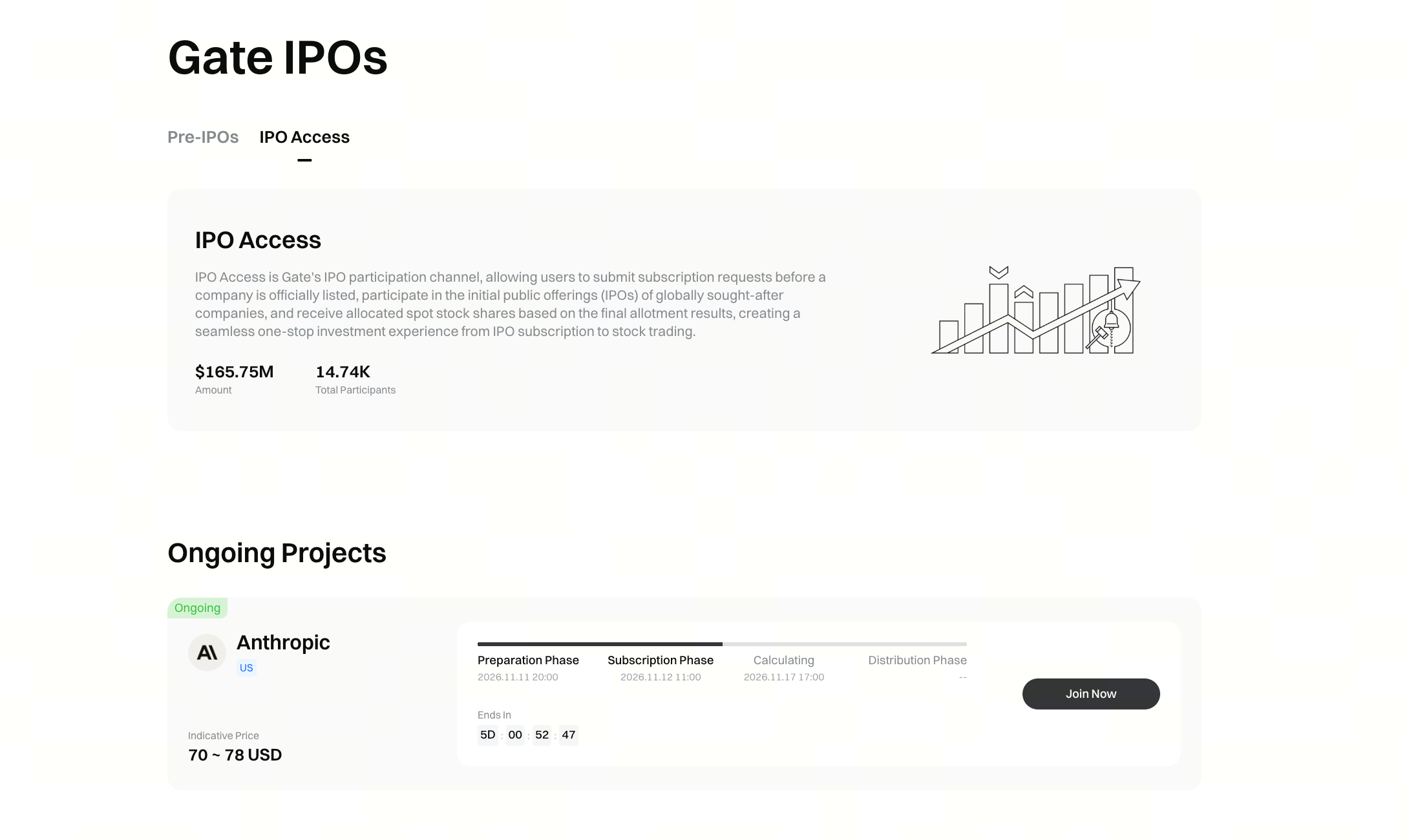
For a multi-broker map that lists Gate as one path, see how to participate in the Anthropic IPO. For click-path and pre-freeze checks, use how to subscribe with USDT. This article only fixes the shares-versus-tokenized boundary and does not repeat the step tutorial.
What Is Tokenized IPO Access (for Example ANTx / xStocks)?
Tokenized IPO Access means allocation is delivered as tokenized equity exposure—not as the same “shares into a brokerage-style stock account” rule set on every venue. In the public comparison sample, Kraken describes Anthropic IPO Access via xStocks, with allocation delivered as ANTx.
Per Kraken Support · Anthropic IPO Access, page last updated November 10, 2026, xStocks are tokenized equities described as 1:1 backed in custody by a regulated entity. IPO xStocks provide price exposure only, do not represent direct ownership of the underlying shares, and typically carry no voting rights; corporate actions may be reflected through mechanisms such as rebasing rather than cash dividends paid directly.
Regional availability, verification, and funding currencies follow the other platform’s account and help-center rules. Naming the sample clarifies product boundaries; it is not a ranking of venues.
How Do Asset Form and Shareholder Rights Differ?
The core split is delivery: Gate’s announcement describes allocated results as actual shares into the Stock Account; the tokenized comparison sample is custody-backed tokenized equity exposure (such as ANTx). Price tracking does not automatically equal the same shareholder-rights set—voting and corporate-action details must be checked against each venue’s live rules and must not be inferred from the phrase “actual shares” alone.
| Feature |
Gate IPO Access (shares) |
Tokenized IPO Access (e.g., ANTx / xStocks) |
| Delivery |
Announcement language: actual shares into Gate Stock Account |
Counterparty language: 1:1 custody-backed tokenized equity exposure (e.g., ANTx) |
| Rights profile |
Announcement confirms tradable actual shares; voting and other details follow Gate Stocks / Stock Account live rules (this article does not invent them) |
Counterparty language is mostly price exposure; typically no voting rights |
| Corporate actions |
Per Gate Stocks / Stock Account live rules and later notices |
Counterparty language may reflect actions via rebase-style mechanisms |
| Fee structure |
Tiered underwriting service fee 5% / 10% on allocated amounts ($50,000 USDT band) |
Offering price + ~5% spread; usually charged only on allocation |
| Trading venue |
Gate Stocks |
Per that venue’s product and transfer rules |
| Account prerequisites |
KYC required; borrowed funds not allowed; institutional accounts and sub-accounts not eligible |
Must meet that venue’s region and product verification rules |
The table puts form, rights, fees, and venue in one checklist: sharing an “Anthropic IPO Access” label still does not mean the same delivery or the same shareholder-rights set. Confirm whether the page shows Stock Account shares or a tokenized ticker before comparing.
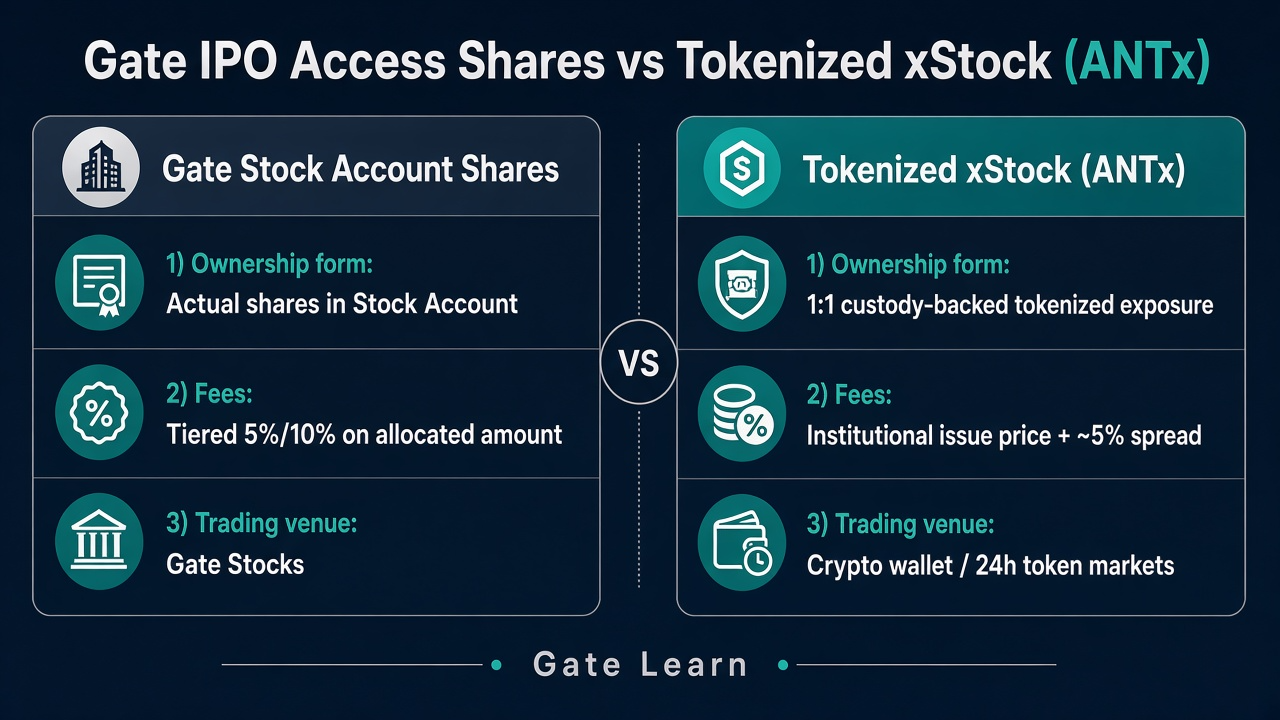 Figure 1. Side-by-side view of Gate Stock Account shares versus Tokenized xStock (ANTx) on ownership form, fees, and trading venue.
How Do Fee and Cost Structures Compare?
Fee comparison starts with “which dollars are charged?” Gate applies tiered fees only to the allocated portion; the comparison sample typically adds about a 5% spread to the institutional offering price and states that the fee usually applies only to allocation received.
Gate’s schedule: 5% on the allocated portion corresponding to ≤$50,000 USDT; 10% on the allocated portion above that band; unallocated amounts are not charged. Effective cost depends on allocation mix, not on the gross indication alone.
Comparison-sample schedule: participate at offering price plus about a 5% spread; the help center states the fee is typically paid only on received allocation, with unallocated funds returned under published rules. Percentage labels cannot be added or subtracted into a “cheaper” verdict—the fee base, currency, and refund rules differ.
How Do Allocation Certainty, Freezes, and Refunds Differ?
Both sides share one point: indicating interest does not guarantee allocation; high demand can produce full, partial, or zero fills. They diverge on fund availability during the window, refund timing, and subsidy language.
On Gate, subscribed funds stay locked (no trade, transfer, or withdrawal) during the window; final price within 20% of the reference price processes automatically, while a move above 20% triggers secondary confirmation. If the platform receives zero allocation, funds return to Spot with a 10% APR subsidy on hourly snapshots (subsidies under $0.5 USDT are not paid); on partial allocation, residual funds return without interest subsidy on the unallocated remainder.
On the comparison sample, submitted interest typically reserves funds rather than debiting immediately; unallocated amounts return after listing-day processing per the help center; allocation is set by underwriters and demand, not as a platform-guaranteed quota. Applying Gate’s APR subsidy to a tokenized path—or treating “reserved” funds as Gate’s locked debit—misreads the rules.
Which Path Matches Which Use Cases?
Match verifiable product conditions: Gate IPO Access fits when the goal matches the announcement—allocated shares into the Stock Account and trading on Gate Stocks; tokenized IPO Access fits when the reader accepts the counterparty’s published tokenized equity exposure. If that venue’s help center separately describes cross-wallet transfer or trading-hours traits, treat those as that venue’s rules—do not fold them into Gate’s product language.
Choose Gate IPO Access (shares) if the goal matches the announcement—post-allocation holdings in the Gate Stock Account and follow-on trading on Gate Stocks; acceptance of USDT indicative subscription, tiered underwriting fees, and the subsidy that applies only when the platform ultimately receives no allocation; and an account that has completed KYC and is not an institutional account or sub-account.
Choose tokenized IPO Access (e.g., ANTx) if the goal accepts the counterparty’s price-exposure tokenized equity language; acceptance of typically no voting rights and corporate actions that may rebase under that venue’s rules; eligibility under that venue’s geography and verification; and fee understanding as that venue’s “offering price + ~5% spread” disclosures.
Both paths include allocation uncertainty, capital lock-up or reservation, and post-listing price risk; regional and account eligibility can hide the entry entirely. Condition fit is not a return comparison and is not investment advice.
Summary
Under the Anthropic IPO Access label, Gate’s shares path and tokenized paths (such as ANTx / xStocks) are not interchangeable on delivery, shareholder-rights language, fee triggers, or trading venue. Gate anchors on Stock Account + Gate Stocks + tiered fees on allocated amounts; the comparison sample anchors on custody-backed tokenized exposure + offering price with about a 5% spread + that venue’s account and transfer rules.
Compare first what you receive, which account it lands in, which dollars fees apply to, and how unallocated funds return. After the mechanisms align, decide whether to read subscription steps or company background next—clear product boundaries beat slogan-style “better” claims.
FAQ
What is the difference between Anthropic IPO Access and tokenized stock IPO Access?
The main split is delivery: per Gate’s announcement, Gate IPO Access credits actual shares to the Gate Stock Account after allocation for trading on Gate Stocks; tokenized paths such as ANTx / xStocks, per counterparty disclosures, deliver 1:1 custody-backed tokenized equity exposure—typically framed as price exposure without voting rights. Fees, accounts, and venues also follow separate platform rules and are not the same product.
Can I buy Anthropic stock with USDT on Gate?
USDT can be used for an indicative Gate IPO Access subscription seeking Anthropic share allocation; allocated shares credit to the stock account. Indicative subscription does not guarantee allocation; outcomes follow official pricing and the platform quota, subject to the live announcement and project page.
Is Anthropic IPO Access allocation guaranteed?
No. Both Gate and the public tokenized IPO Access sample state that fills may be full, partial, or zero. Allocation depends on demand and underwriter/platform quota constraints and is not a first-come, first-served certainty.
What are the risks of participating in IPO Access?
Key risks include no guaranteed allocation; capital locked or reserved during the window; post-listing price moves in either direction; and different rights, fees, and regional limits between shares and tokenized paths. Also confirm KYC, borrowed-fund bans, institutional/sub-account blocks, and the other venue’s geographic availability.
How do Gate share-path fees compare with ANTx-style tokenized fees?
Gate charges a tiered underwriting service fee of 5% on the allocated portion corresponding to ≤$50,000 USDT and 10% above that band; unallocated amounts are not charged. The comparison sample commonly uses offering price plus about a 5% spread, usually only on allocation received. Different fee bases and refund rules mean percentage labels alone are not comparable.