For beginners comparing automation paths on Gate, the decisive split is strategy source and execution control. Automated crypto trading groups all three under “rules or systems replace part of manual work,” yet Gate AI assists decisions, Trading Bots enforce preset grids and rebalance logic, and Copy Trading delegates signal timing to a Lead Trader. Readers who need product-level detail on the assistant layer can cross-read Gate AI features and architecture; those focused on Copy Trading should start from the Gate futures copy trading guide.
Key Takeaways
- Gate AI is an assistant layer—natural-language queries and analysis do not, by default, place trades without a separate user action on bots or Copy Trading.
- Trading Bots execute parameterized rules (Spot Grid, Moving Grid, Smart Rebalance, Recommended Bots) once configured; Arithmetic Grid and Geometric Grid define how prices step inside the range.
- Copy Trading links a Copier to a Lead Trader via Quick Copy or Advanced Copy; past Lead Trader curves are not guarantees of future results.
- Many users combine paths—Gate AI to learn parameters, Trading Bots for range-bound spot logic, Copy Trading for directional futures exposure—with distinct risk checks for each.
What Is AI Trading on Gate?
AI trading, in the Gate product context, refers to Gate AI and related modules such as Ultra AI—conversational tools that answer product questions, summarize market context, and help interpret strategy settings. Gate AI sits upstream of order placement: it can clarify how AI Smart Grid differs from Manual Grid Setup, or what Coin Accumulation Mode implies inside a grid bot, but the assistant does not silently take custody of account actions.
That boundary matters because “AI trading” is often used loosely online to mean fully autonomous agents. On Gate, Gate AI and Ultra AI primarily reduce search friction and translate parameters into plain language; each trade or automation start remains an explicit product choice on Trading Bots or Copy Trading.
What Are Trading Bots?
Trading Bots on Gate are automated strategy runners that place and manage orders from preset logic. The category spans spot and advanced grid tools:
| Bot type |
Core behavior |
Typical use case |
| Spot Grid |
Buys lower and sells higher inside a price band |
Range-bound spot pairs |
| AI Smart Grid |
Suggests or adjusts grid parameters with AI assistance |
Faster setup vs pure Manual Grid Setup |
| Moving Grid |
Shifts the active band as price drifts |
Trending markets within a managed corridor |
| Smart Rebalance |
Periodically restores target portfolio weights |
Multi-asset spot allocation |
| Recommended Bots |
Curated templates with disclosed parameters |
Entry path before custom Manual Grid Setup |
Grid mechanics rely on Arithmetic Grid (equal price steps) or Geometric Grid (equal ratio steps). Coin Accumulation Mode variants may accumulate base asset instead of recycling all proceeds into quote currency—behavior depends on the specific bot sheet.

According to Gate Spot Grid documentation, a standard run moves through initialization, order placement, cyclic fills inside the band, and termination with settlement. Bots excel when rules are explicit and testable; extended band breaks require user adjustment. See crypto trading bot for broader taxonomy.
On Gate, users typically size each bot against available balance, watch whether price revisits the grid lines, and accept that moves outside the band pause the loop until parameters change. Fills inside the bot stay rule-driven—the system does not improvise discretionary entries the way a human trader might.
What Is Copy Trading?
Copy Trading lets a Copier replicate trades from a Lead Trader on supported markets—commonly futures on Gate. Quick Copy offers a streamlined follow flow with platform-defined guardrails; Advanced Copy exposes more granular copy multiple rate settings, margin behavior, and stop conditions.
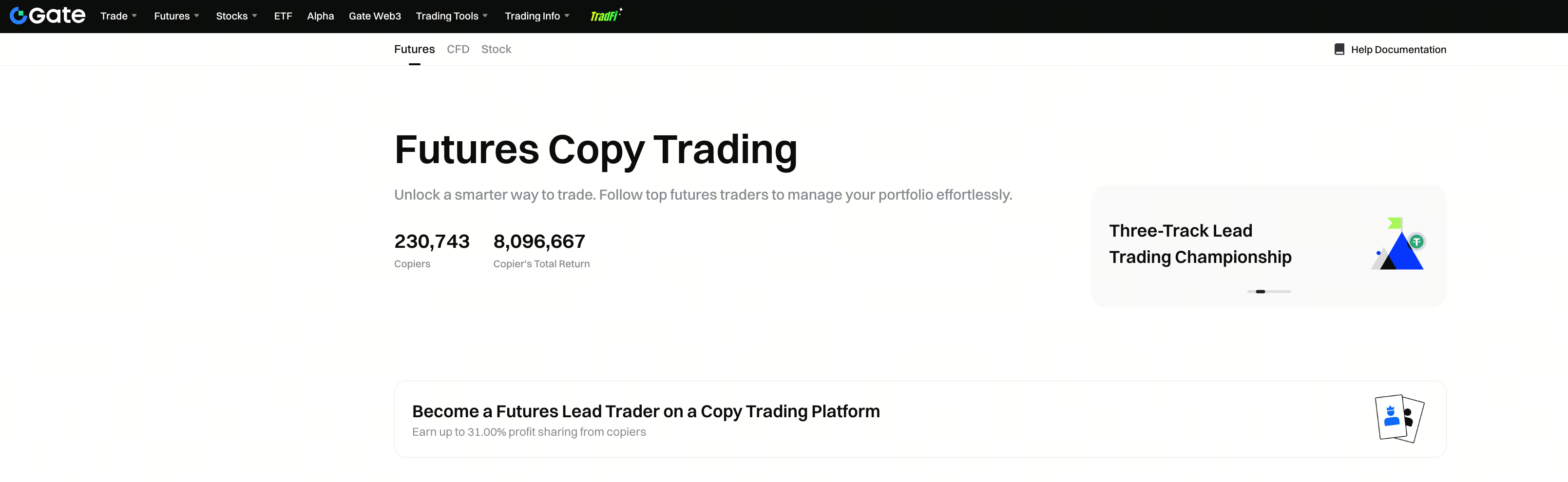
Execution is discretionary at the source: the Lead Trader decides entries, sizing, and exits; the Copier’s account mirrors within configured limits. Slippage, latency, and minimum notionals mean copies are approximate, not identical, to the Lead Trader’s fills.
Gate documents futures copy mechanics—including margin mode interactions and copy multiple rate—in the Gate futures copy trading guide. Copiers should read copy trading risk management before allocating size.
On Gate, Copy Trading mirrors Lead Trader fills within the Copier’s caps. Strategy timing stays with the Lead Trader; Copiers choose how much capital to allocate, how long to stay copied, and whether Quick Copy or Advanced Copy fits. Leaderboard history describes past results only—it is not a forecast.
AI Trading vs. Trading Bots vs. Copy Trading: Side-by-Side
| Dimension |
Gate AI (AI trading) |
Trading Bots |
Copy Trading |
| Strategy source |
User questions + platform knowledge; optional AI parameter hints |
User or template parameters; AI Smart Grid / Recommended Bots assist setup |
Lead Trader discretion |
| Execution |
User-initiated orders or bot/copy activation |
Automatic within bot rules once started |
Automatic mirroring after copy relation is set |
| Best-fit market view |
Any—assistant is market-agnostic |
Range and rule-driven paths (grids, rebalance) |
Directional strategies tied to Lead Trader skill |
| Transparency |
Explanations and links to help topics |
Open parameters (grid range, counts, modes) |
Lead Trader stats, history, drawdowns (past, not predictive) |
| Primary risk |
Misinterpretation of answers; overconfidence in suggestions |
Parameter drift, band breaks, fee drag |
Lead Trader drawdowns, leverage mismatch, copy lag |
In short: Gate AI helps you interpret settings before you act; Trading Bots run written rules after you configure them; Copy Trading mirrors a Lead Trader’s timing within your copy limits. None of the three removes exchange-level risk—liquidation on leveraged copy positions, band breaks on grids, or acting on incomplete AI summaries still sit with the account holder. Fees also differ by path: ordinary trading fees on fills, possible profit-sharing on copy relations, and fee drag on each grid leg.
Which Path Fits Which Beginner Profile?
Gate AI keeps decision control with you—each trade or bot start needs a separate confirmation. Trading Bots trade some control for consistency once parameters are set; Manual Grid Setup suits tight oversight, AI Smart Grid suits faster band suggestions. Copy Trading shifts signal timing to the Lead Trader while Copiers keep risk caps via copy amount and Quick Copy or Advanced Copy stops.
Choose Gate AI first if the blocker is vocabulary—understanding Moving Grid, margin modes, or how Smart Rebalance differs from Spot Grid—before any automation is enabled.
Choose Trading Bots if the market thesis is range-bound or allocation-based, parameters can be stated clearly, and the user will monitor band breaks and fees. Spot Grid with Arithmetic Grid is a common learning path; Geometric Grid suits wider percentage swings.
Choose Copy Trading if the user accepts delegated timing on futures, has reviewed Lead Trader history and drawdowns, and has set copy limits aligned with account size. Selection discipline matters; see our Lead Trader selection tips.
Combinations are normal—Gate AI to decode bot sheets, Spot Grid for spot exposure, a capped Advanced Copy sleeve for futures—each with its own risk budget.
How to start on Gate: open Gate AI to clarify product names, then open Trading Bots or Copy Trading from the same menu. Beginners often use Ultra AI or Recommended Bots for a first Spot Grid, or Quick Copy after screening Lead Traders. Read help topics on price bands, fees, and execution rules before sizing live capital.
Before enabling any path, check three things: who writes the strategy, what you can see on-screen, and how quickly you can stop it.
Risks and Limitations to Compare
Gate AI: Answers depend on underlying help and data feeds; cross-check Spot Grid help for order-critical fields. Trading Bots: Grids assume price revisits the band; fees on each leg reduce net spread; AI Smart Grid inputs may not match future volatility. Copy Trading: Past Lead Trader stats are not predictive; funding and liquidation rules in Gate funding documentation apply to Copiers; copy lag can worsen fills in fast markets.
Common risks and how to avoid them: treat assistant text as a starting point, not order instructions; size bots smaller than maximum balance; cap copy margin and set stop ratios; recheck strategy fit when market regime shifts.
Summary
On Gate, the useful comparison is who writes the strategy and what runs automatically. Gate AI and Ultra AI help you understand products; Trading Bots enforce grid and rebalance rules after you configure them; Copy Trading mirrors Lead Traders through Quick Copy or Advanced Copy. Spot Grid, AI Smart Grid, Smart Rebalance, and Recommended Bots cover parameterized automation; Copiers still need to vet Lead Traders and margin settings. Map your goal—learn, automate a range, or follow a Lead Trader—to the matching product, then keep a separate risk limit for each path.
FAQ
Does Gate AI automatically place trades like a Trading Bot?
No. Gate AI and Ultra AI are conversational assistants. They can explain settings and market context, but orders still need explicit confirmation inside Trading Bots or Copy Trading. The assistant layer does not place trades on its own unless a separate bot or copy relation is already running.
What is the main difference between Trading Bots and Copy Trading?
Trading Bots follow preset rules such as Spot Grid or Smart Rebalance from parameters you or a template supply. Copy Trading mirrors a Lead Trader’s orders, subject to copy multiple rate, lag, and platform minimums. Bots encode the plan in grid or rebalance math; copy imports another Lead Trader’s timing.
Can AI Smart Grid replace Manual Grid Setup entirely?
No. AI Smart Grid speeds up suggested bands and density, but you still confirm the range, Arithmetic or Geometric Grid, and capital. Manual Grid Setup remains the path for fully custom grids and advanced Moving Grid or Coin Accumulation Mode choices. AI shortens setup; it does not replace a fee and range check.
Is Copy Trading safer than running a Spot Grid bot?
Neither is inherently safer. Spot Grid can lose when price leaves the band and fees eat the spread; Copy Trading can lose from Lead Trader drawdowns or leverage mismatch on futures. Safety depends on size, stops, and whether the approach matches current conditions—compare rules and history before allocating.
Can beginners use all three at the same time?
Yes, if each path has its own budget. A common pattern is Gate AI for learning, a small Spot Grid for spot range logic, and a capped Advanced Copy relation for futures—monitored separately. Start small, watch how each path behaves, and scale only after reviewing results rather than headline returns.